
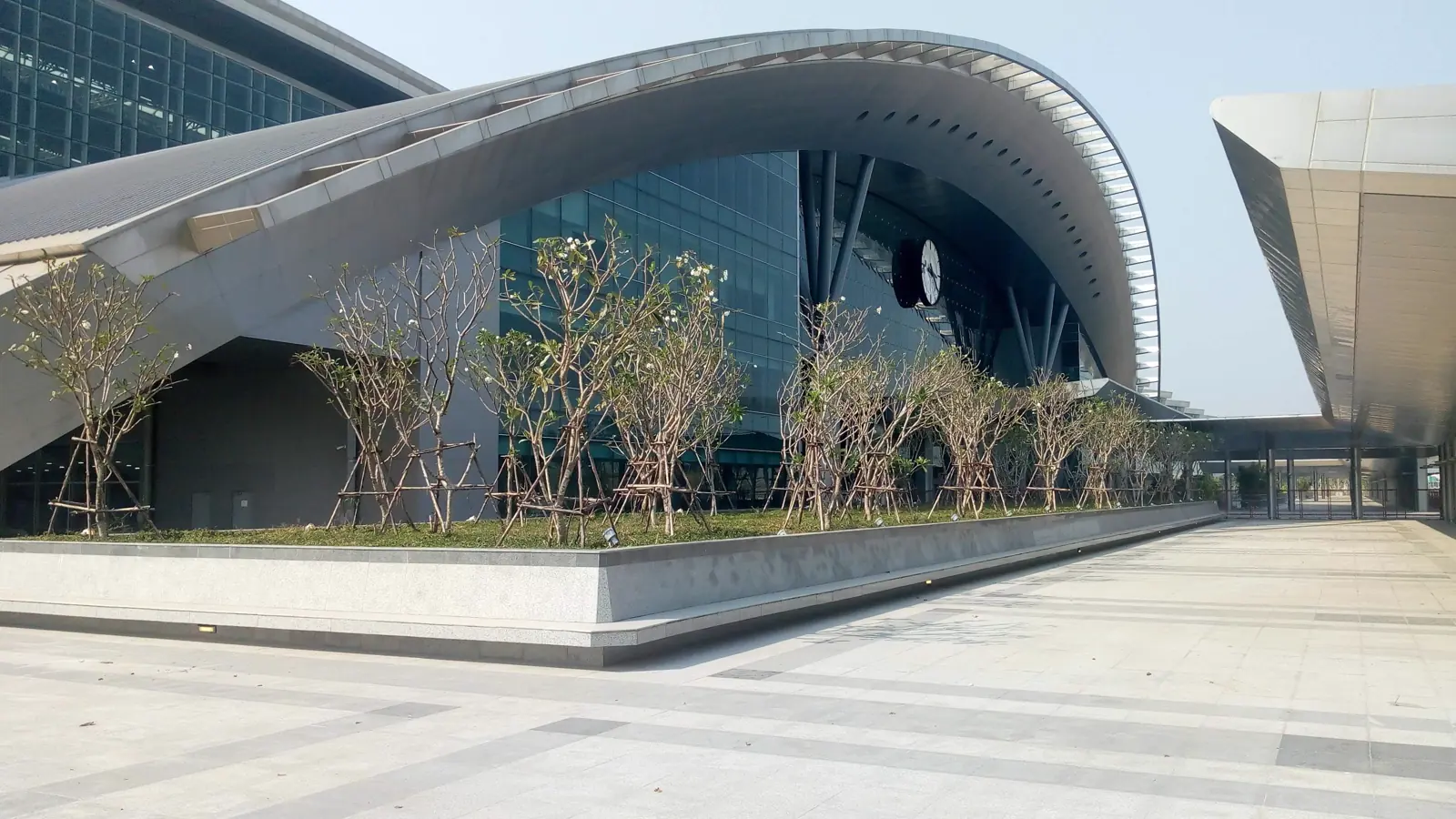
Krung Thep Aphiwat is connected to Bang Sue MRT, but the Blue Line only becomes useful after its first trains start running. Your long-distance ticket then has its own station process. If those two clocks sit too close together, the cheaper urban train is solving the wrong problem.
Do the live clock check now
Verify the city train, main train and backup ride separately
Start with your exact Blue Line origin, then check the live terminal board. Only after both clocks fit should you decide whether the MRT route has enough margin.
If you are choosing between rail and flying to northern Thailand, first read Bangkok to Chiang Mai: sleeper train or flight. This page assumes the train is already the plan and answers the smaller but surprisingly important question: how should you leave the hotel?
Use three departure bands, not one universal rule
Checked on 23 August 2026, the State Railway of Thailand’s current timetable shows long-distance departures from Krung Thep Aphiwat beginning in the morning, including services around 07:30, 07:50 and 09:05 on current published routes. Bangkok MRT Blue Line first trains at central stations are generally around 06:00, varying slightly by station and direction.
That creates three useful planning bands. These are Do Thailand decision bands, not SRT or MRT minimum connection times.
Before about 07:30
I would normally take Grab, a hotel taxi or another confirmed car. The MRT’s first-service clock leaves too little useful room once you include the walk into your origin station, the ride, Bang Sue Exit 3, the terminal interior and the long-distance gate process.
07:30–08:15
MRT can work if the hotel is genuinely close to a Blue Line entrance, luggage is easy to handle and the live first-train time produces a comfortable arrival. If any one of those is weak, take the car.
After about 08:15
From a Blue-Line hotel area, the MRT usually becomes the lower-friction choice because you have enough margin for ordinary station walking without treating the first train as a race.
The point is not that 08:15 is magical. The point is to stop asking, “How long does the MRT take?” and ask, “What happens if I miss the first train I intended to catch?”
First check whether your hotel actually touches the Blue Line
Bangkok hotel names often advertise “near BTS” or “near MRT” as if the two systems are interchangeable. Before an early train, they are not. A hotel beside the Blue Line gives you a direct urban-rail path to Bang Sue. A hotel beside only the BTS may require a walk, an interchange and another station entrance before the useful part of the journey even begins.
Sukhumvit is directly on the Blue Line, so this is one of the cleanest hotel-to-station rail cases. If you are still choosing within the area, the Asok vs Phrom Phong decision matters because Asok gives you the MRT without needing a BTS hop first.
Both sit on the Blue Line. For an 08:00-plus departure with manageable luggage, rail is usually more predictable than asking Bangkok road traffic to cooperate. The broader Siam vs Silom guide explains why this dual-rail geography can matter beyond the train day.
These are excellent Bangkok bases, but they are primarily BTS-led. For a normal daytime trip you can interchange. Before an early train, I would not add an unnecessary transfer simply to prove that public transport is possible. See Sukhumvit vs Siam if this is still a hotel-location decision.
Some Old Town hotels are genuinely walkable to the Blue Line; others are not. If your hotel requires a dark pre-dawn walk through small streets before you even reach MRT, a door-to-door car may be the more sensible transport choice. The Siam vs Old Town comparison is useful before booking.
Riverfront hotels vary widely in road and rail access. When the first move is already a shuttle boat, taxi or long walk, a single car to Krung Thep Aphiwat is usually the cleaner early-morning chain. See Riverside vs Sukhumvit for the bigger stay trade-off.
This is why “hotel near BTS” is not enough. A property can be excellent for sightseeing and still be awkward for a 07:30 long-distance train. If you are comparing two otherwise similar rooms, the near BTS vs deep-soi hotel guide shows how the final walk changes transport value.
The MRT journey has five pieces, not one
Hotel room → MRT entrance
Count the actual door-to-platform walk with luggage. A five-minute daytime stroll can feel different at 05:40 in rain, with a roller bag and a quiet side street.
Wait for the first useful Blue Line train
BEM’s current timetable puts first services around 06:00 at many central stations. Check your exact station and direction the night before rather than assuming every entrance opens at the same practical moment.
Ride to Bang Sue (BL11)
Bang Sue is on the Blue Line. The rail ride is predictable; the vulnerability is everything you have scheduled tightly around it.
Use Exit 3 for the main station connection
BEM currently labels Bang Sue MRT Exit 3 for “Bang Sue Grand Station,” the former name of Krung Thep Aphiwat Central Terminal. BEM also lists an elevator at Exit 3, which matters if you have a suitcase.
Find the correct long-distance gate and platform
SRT advises passengers on current northern long-distance services to be at the departure gate around 30 minutes before the train. It also requires ticket scanning before access to the second-floor platforms at Krung Thep Aphiwat.
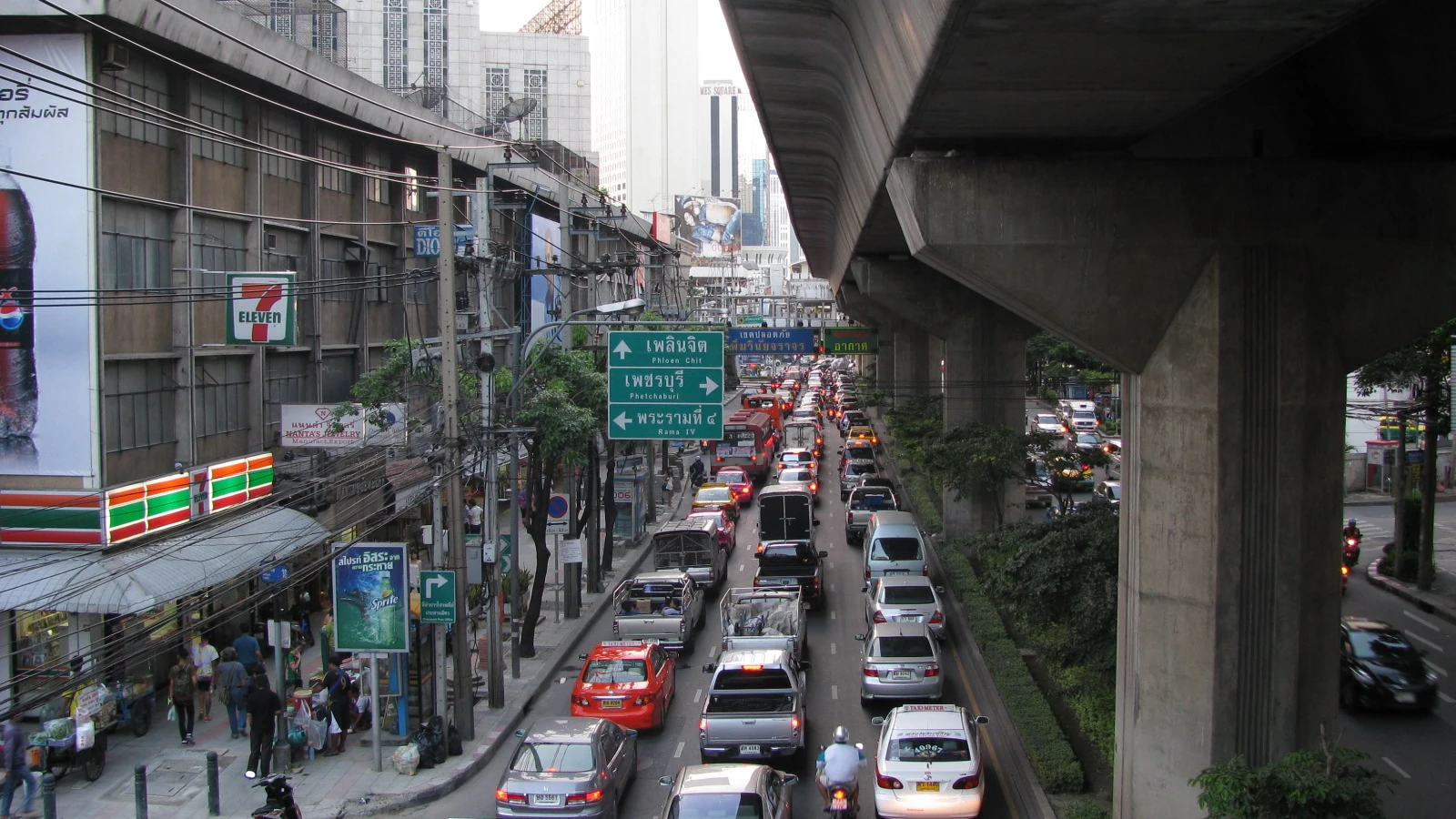
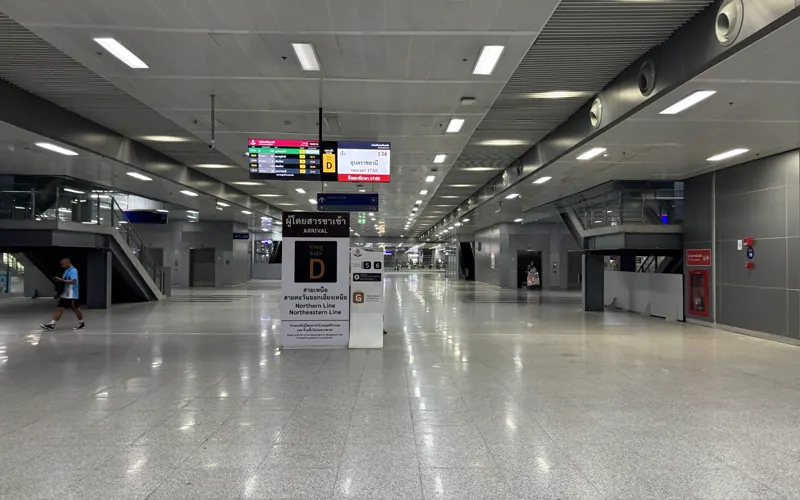
Swipe to compare the MRT handoff and the terminal interior.
Do not arrive with only a screenshot of your rail ticket
For long-distance trains at Krung Thep Aphiwat, SRT currently states that passengers should scan an original ticket, PDF file or the ticket opened in the D-Ticket app before platform access. Its published guidance specifically says a photo of the original ticket is not accepted for this scan. Save the actual PDF offline if you do not want your station entry to depend on mobile reception.
Build the station buffer backward from the gate, not from the curb
“Arrive at the station” is too vague for this terminal. Your car can reach the property while you still need to find the correct entrance, enter a large concourse, read the departure board, reach the appropriate waiting zone and complete the ticket check. The MRT version adds the handoff from Bang Sue station before that terminal sequence begins.
Start with the gate time you want, then reserve terminal time, connection time and a disruption margin. Only the minutes that remain belong to the hotel-to-station journey. This method avoids a common mistake: calculating a road or rail duration accurately while assigning no time to the much larger building at the end.
Ticket readiness belongs inside the same buffer. Keep the actual PDF or D-Ticket record available offline, confirm the passenger details, and place the screen brightness high enough for scanning. If you still need a ticket counter, SRT's current station FAQ points passengers to counters at terminal gates 4 and 13; that is a different arrival plan from walking straight to platform access.
The Red Line is useful, but it does not fix every hotel origin
Krung Thep Aphiwat is also the Red Line hub, and SRT currently publishes daily Red Line operation from early morning. That does not automatically give a Sukhumvit, Silom or Old Town hotel a direct Red Line route. You first need a practical path to one of its stations. Do not combine the Red Line opening time with the Blue Line route described on this page as if they were the same first train.
The network distinction is especially important around Don Mueang. The DMK to Sukhumvit via the Red Line guide follows a different direction and interchange problem. For a hotel-to-long-distance-train departure, choose the network that touches your actual hotel, not the one whose map looks closest to the terminal.
Luggage changes the winner before it changes the timetable
One cabin-sized roller and a familiar MRT entrance are a very different task from two large suitcases, a deep-soi walk and an elevator search. BEM currently lists an elevator at Bang Sue Exit 3, which helps at the station end, but you must also audit elevator access at your origin. A step-free destination cannot rescue a difficult first ten minutes.
Two friends can split navigation and bags, but they should still agree on the departure clock the night before. Families should count child pace, toilet stops and the possibility that the first intended train is missed. Solo travelers should keep the hotel lobby as the waiting point for a booked car and verify the vehicle registration before leaving the staffed space.
That small detail is more important than shaving three minutes from the hotel journey. The station is large, and an early departure is exactly when you do not want to discover that the image in your phone gallery is the wrong ticket format.
The 07:30 case: possible by MRT does not always mean sensible
Imagine a 07:30 departure from Krung Thep Aphiwat
Your hotel is near Sukhumvit MRT. The current Blue Line first-service window is around 06:00, so on paper the trip is plausible. But your useful buffer must also absorb the walk into Sukhumvit station, waiting for the train, the Blue Line ride, Bang Sue Exit 3, the walk into the terminal and the SRT gate process.
If you are carrying one small suitcase and know the station entrance, I would consider the MRT. If you have two large bags, a hotel five to ten minutes down a soi, or any anxiety about finding the correct entrance at dawn, I would book the car and spend the saved mental energy on the long-distance journey.
By contrast, a 09:05 departure changes the same hotel completely. The MRT has moved from “first-service puzzle” to ordinary city transport. That is the decision shift this guide is trying to capture.
Why Grab or a hotel taxi wins before the MRT clock opens up
A direct car buys you one continuous handoff: hotel lobby to Krung Thep Aphiwat. It does not guarantee a traffic-free drive, but at very early hours it removes the station-opening question, ticketing at the MRT and the luggage transfer through Bang Sue.
Grab Thailand currently offers Advance Booking in Bangkok. For a high-consequence train departure, I would arrange the ride the night before rather than open the app at the exact moment you need to leave. The hotel’s own booked taxi is also perfectly reasonable if the desk can confirm the pickup time and destination.
Use the full destination name Krung Thep Aphiwat Central Terminal. Do not casually ask for “Bang Sue station” because the area includes Bang Sue Junction and the MRT station as separate transport references. The main long-distance terminal was formerly called Bang Sue Grand Station, which is why that older wording still appears on BEM’s Exit 3 signage.
For solo travelers, the hotel exit can matter more than the vehicle
There is no reason to treat an early Bangkok departure as inherently unsafe, but the environment changes before the city is fully awake. If your hotel is deep inside a quiet soi, the weakest part of the MRT plan may be the first ten minutes on foot, not the train system.
For a woman traveling alone with luggage, I would favour the direct car when it lets you wait inside a staffed lobby until the vehicle is visible. If the hotel opens directly onto a busy, lit MRT entrance and your departure is late enough for normal first-train service, public transport can be the calmer option because the route is fixed and you avoid road uncertainty.
Rain is another tie-breaker. A covered lobby pickup can be worth more than a modest fare saving when you have a large suitcase, travel clothes you want to keep dry and a long train day ahead.
Do not move hotels just for one train unless the base is already wrong
It is easy to over-correct after seeing Krung Thep Aphiwat on a map and decide you should spend the last night near Bang Sue. For most visitors, one confirmed car solves the problem more cleanly than another checkout, another check-in and giving up a hotel area you actually wanted.
If you are still choosing a first-trip Bangkok base, use Where to Stay in Bangkok rather than optimising the whole trip around one station departure. If the train is only one piece of a wider airport-heavy itinerary, compare BKK vs DMK and the separate BKK to DMK airport-transfer guide before locking the sequence.
A simple hotel-area decision board
- Asok/Sukhumvit + train after about 08:15: MRT is my default.
- Silom/Lumphini + train after about 08:15: MRT is also strong.
- Siam/Chit Lom + train around 07:30: I would usually take a direct car rather than add BTS-to-MRT friction.
- Old Town + hotel genuinely beside Sam Yot/Sanam Chai: MRT can work once the first-train timing leaves enough margin; otherwise use a car.
- Riverside + early train: direct car is usually the cleaner chain.
- Any area + large luggage, rain or deep-soi hotel: the car gains value quickly.
If the next leg after Bangkok is Pattaya rather than a train journey, do not use this station logic at all; the BKK to Pattaya bus-vs-private-transfer guide solves a different gateway problem.
Check these two live sources the night before
Transport timetables change. The useful habit is to verify the two clocks separately: first the Blue Line service from your exact MRT station, then the SRT departure from Krung Thep Aphiwat.
My pick
Before the MRT has enough operating margin, buy one continuous car ride. Once the Blue Line is comfortably running, use it from a Blue-Line hotel and save the car for hotel areas that require an extra interchange or awkward dawn walk.
That keeps the decision proportional. You do not need to be loyal to public transport or ride-hailing. You need to reach the train with enough time left that the station itself is not the stressful part of the journey.
Lock the route the night before
Use live clocks, then save the exact terminal name
Recheck your origin station and main-train departure. If the rail margin has disappeared, schedule the direct ride and use “Krung Thep Aphiwat Central Terminal” as the destination.