
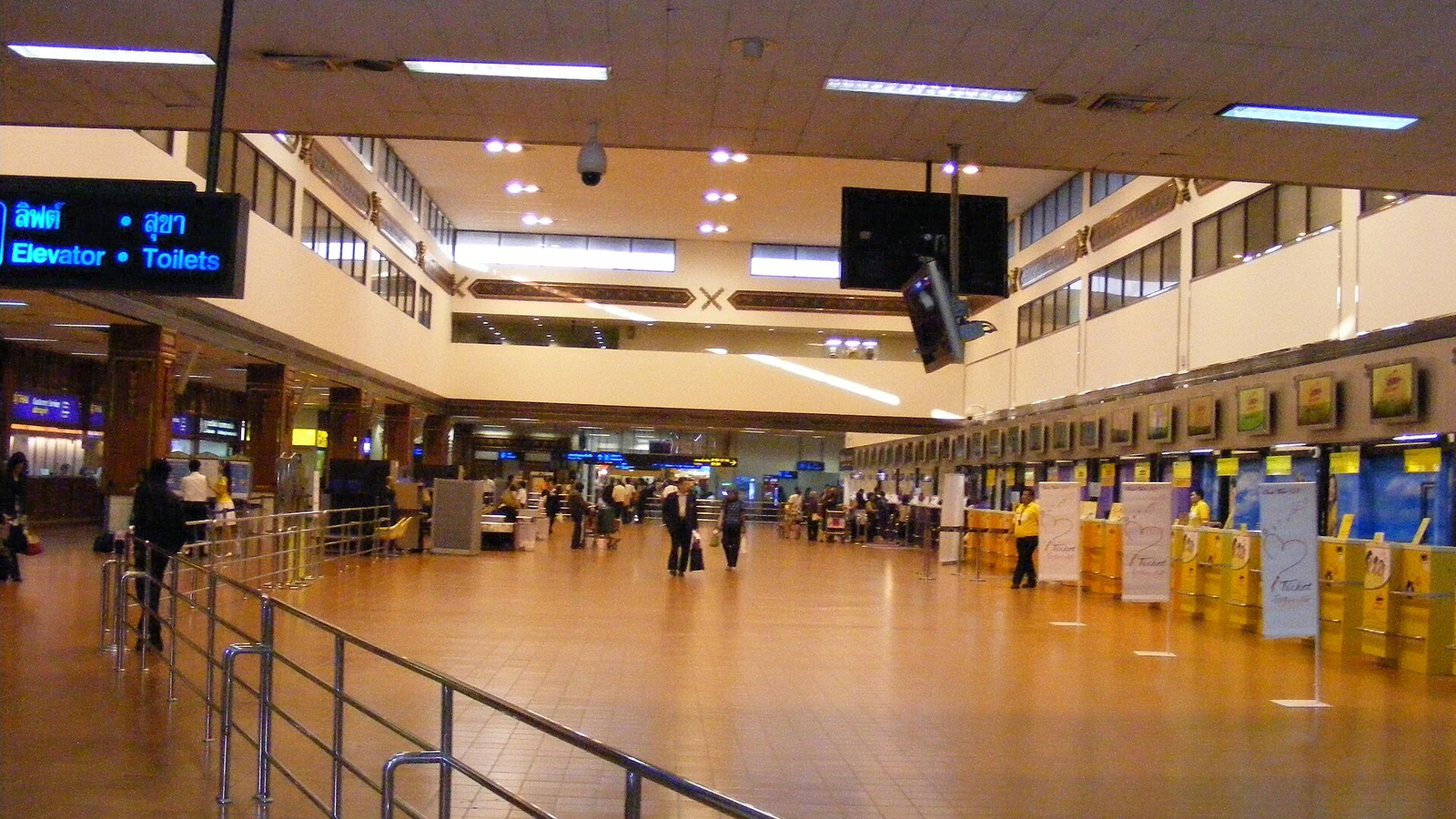
Don Mueang is not Suvarnabhumi with a different airport code. The rail logic is completely different. From DMK, the useful public-transport spine is the SRT Red Line south to Krung Thep Aphiwat, then the MRT Blue Line from Bang Sue toward Sukhumvit. The question is not whether Bangkok has a train from the airport. It does. The question is whether your hotel lets that train chain finish cleanly.
If you are still choosing which Bangkok airport to use, start with BKK vs DMK. This page assumes the flight is already arriving at Don Mueang and you are heading to Sukhumvit.
The useful rail chain is DMK → Krung Thep Aphiwat → Bang Sue MRT → Sukhumvit
Airports of Thailand currently lists the Red Line Suburban Train among Don Mueang Airport's public-transport options. SRTET's current route map marks Don Mueang as the airport station and Krung Thep Aphiwat as the interchange with the Blue Line. The current adult Red Line fare table lists Don Mueang to Krung Thep Aphiwat at 33 baht.
BEM's current Bang Sue station information identifies Exit 3 with the rail terminal connection—the page still labels it “Bang Sue Grand Station,” the former name of Krung Thep Aphiwat—and confirms elevators and escalators. At the other end, BEM lists Sukhumvit as BL22 and Exit 3 as the connection to Asok BTS.
That makes Asok the cleanest Sukhumvit target from DMK by rail. If you have not chosen the hotel yet, compare where to stay in Bangkok and Asok vs Phrom Phong before assuming all of Sukhumvit has the same airport access.
Sukhumvit is where the rail answer splits into three different trips
Asok / Terminal 21
Red Line to Krung Thep Aphiwat, one station-complex handoff to Blue Line, then MRT straight to Sukhumvit. If reception is close to the exit, the chain is coherent.
Nana / Phrom Phong
You can continue by transferring from MRT Sukhumvit to BTS Asok. With a small bag, that may still be fine. With a large case, it becomes another platform, gate and lift/escalator problem.
Thong Lo or deep sois
The farther you ride east on BTS—or the farther reception sits from the station—the less important the Red Line's low fare becomes. The final kilometre can decide the whole trip.
For hotels advertised as “near BTS,” check the exact pin rather than the marketing phrase. Our near BTS vs deep-soi hotel guide explains why a property can be in an excellent district yet still be annoying with luggage. If you are choosing farther east, Phrom Phong vs Thong Lo gives the more useful micro-location trade-off.
The 33-baht Red Line leg is not the number that should decide this
The Red Line fare is easy to see; the handoffs are harder to price. SRTET's current fare table puts Don Mueang–Krung Thep Aphiwat at 33 baht, and its FAQ states that Red Line service operates daily from 05:30 to 24:00. BEM publishes Blue Line first/last-train information by station, with late-evening service through Bang Sue and Sukhumvit.
None of those facts means your airport-to-hotel journey is “33 baht” or that a flight landing near the final train gives you a safe rail connection. You still have to clear the aircraft, collect bags, reach the station, wait, transfer between rail systems and get from the last station to reception.
| Arrival setup | Better default | What changes the answer |
|---|---|---|
| Domestic arrival, one cabin-size bag, hotel beside Asok/Sukhumvit | Red Line + MRT | The train chain ends close to the hotel, so the transfer buys traffic independence without creating a difficult last mile. |
| International arrival, checked luggage, Asok hotel | Still possible by rail | Use actual arrival-hall time, not touchdown. Immigration and baggage can consume the margin you thought you had. |
| Two travelers with large suitcases, Phrom Phong hotel | Compare a direct car | The second transfer to BTS plus the final walk makes the rail option physically busier. |
| Hotel deep in a Sukhumvit soi | Direct car often wins | Door-to-door removes the final exposed walk or short app ride. |
| Late arrival with uncertain baggage timing | Direct car | Rail operating hours are fixed; the baggage belt is not. |
| Solo traveler in daylight with a small bag | Rail is a good default | The official rail chain is legible, avoids road-price uncertainty and keeps most of the trip inside staffed stations. |
At Krung Thep Aphiwat, count what you are carrying—not just how many lines you ride
The interchange is not a cross-platform hop. You are changing from the Red Line rail terminal environment to Bang Sue MRT. BEM currently lists elevators at Bang Sue Exits 1 and 3 and escalators at all entrances/exits, which helps, but a lift on a map does not make two heavy suitcases light.
Rail still feels reasonable
One wheeled case or backpack, no child equipment, no urgent appointment after check-in, and a hotel whose final station exit is genuinely useful.
Pay to remove the handoffs
Two large cases, awkward carry-ons, several people sharing one vehicle, rain, a low phone battery, or a hotel where you would need another ride after the station anyway.
This is the reverse of the question in our Bangkok hotel to Krung Thep Aphiwat guide. For a train departure, protecting a fixed departure time can justify a car. From DMK, the issue is whether you want to manage the terminal-to-MRT handoff immediately after a flight.
Domestic and international arrivals should not use the same “landing time” rule
Airports of Thailand's current DMK arrival procedure separates international passport control and customs from the domestic process before passengers reach public transport. That makes a scheduled 21:30 landing a very different rail proposition depending on whether you are stepping off a domestic flight with hand luggage or clearing an international arrival with checked bags.
Use arrival-hall time as the decision point. Once you have your bag and are landside, check the current Red Line timetable and how much service margin remains. If the rail chain now feels rushed, change modes. There is no prize for preserving a public-transport plan after the assumptions behind it have changed.
If your trip involves changing between Bangkok's two airports instead of going into the city, use the separate BKK to DMK transfer guide. The free inter-airport shuttle has connecting-passenger rules and should not be confused with ordinary transport into Sukhumvit.
The airport bus is not a secret shortcut to Sukhumvit
DMK also has the A1–A4 airport bus network. Airports of Thailand currently lists A1 toward Mo Chit/Chatuchak and other routes toward different parts of Bangkok. That can be useful for the right destination, but for Sukhumvit it usually replaces the Red Line with a road segment and still leaves you needing BTS or another connection.
In other words, do not add the bus merely because it looks simpler than changing at Krung Thep Aphiwat. If your hotel is rail-friendly, the Red Line–MRT chain is the cleaner public-transport comparison. If your hotel is not rail-friendly, compare a direct car rather than assembling a bus-plus-train route to prove that public transport can be done.
A taxi or Grab starts winning before the rail system actually closes
Direct road transport is not only a “trains have stopped” fallback. It can be the better arrival choice earlier in the evening if your usable rail margin is thin, you are tired, or your hotel entrance is awkward.
Don Mueang's current official taxi information places metered taxi service at International Terminal 1, Level 1, Gate 8 and the domestic Terminal 2 area next to Gate 15. A 50-baht airport surcharge is added to the meter, expressway tolls are paid by the passenger, and published luggage-service fees can apply. AOT also lists a Grab service counter for the domestic terminal at Level 1, Gate 14, with fares shown in the app.
For a woman arriving alone, the useful distinction is control over the final leg. Rail can feel very straightforward when you emerge at a busy, well-connected Asok exit and walk a short distance to a known hotel. A direct car can feel much better when the alternative is changing systems with luggage and then walking ten or fifteen minutes down a quieter side street after dark. Neither mode is inherently the “safer woman option”; the exact station exit, waiting environment and hotel pin matter more.
Want one airport-to-hotel handoff instead?
If the luggage, late-arrival or deep-soi tests point away from rail, compare a prebooked Don Mueang Airport transfer to a central Bangkok hotel. Check the current vehicle, luggage and pickup terms for your date before booking.
Check the DMK transfer optionDo not copy your BKK arrival plan across to DMK
If you have used Airport Rail Link from Suvarnabhumi before, it is tempting to think “airport train, then BTS.” From Don Mueang, that mental model causes unnecessary transfers. The useful spine is Red Line to Krung Thep Aphiwat, then Blue Line to Sukhumvit. BTS is only the third rail system if your hotel actually needs it.
Our BKK to Sukhumvit guide has different interchange logic through Makkasan or Phaya Thai. If airport access is influencing the hotel itself, compare Sukhumvit vs Siam and Siam vs Phaya Thai rather than assuming Sukhumvit is always the easiest arrival base.
Your departure day can have a different answer
A rail arrival and a car departure are not inconsistent. On arrival day, traffic independence and a relaxed afternoon may make Red Line + MRT appealing. On departure day, an early flight, several days of shopping, extra luggage or a fixed bag-drop deadline can make a direct car the smarter reverse trip.
That is the practical rule for DMK to Sukhumvit: count handoffs after you know the hotel pin. One meaningful transfer and a short final walk? Use the Red Line. Two rail changes plus a deep-soi finish? Let a car do the whole job.
Do Thailand separates editorial recommendations from commercial links. See our Editorial Policy and Affiliate Disclosure.