
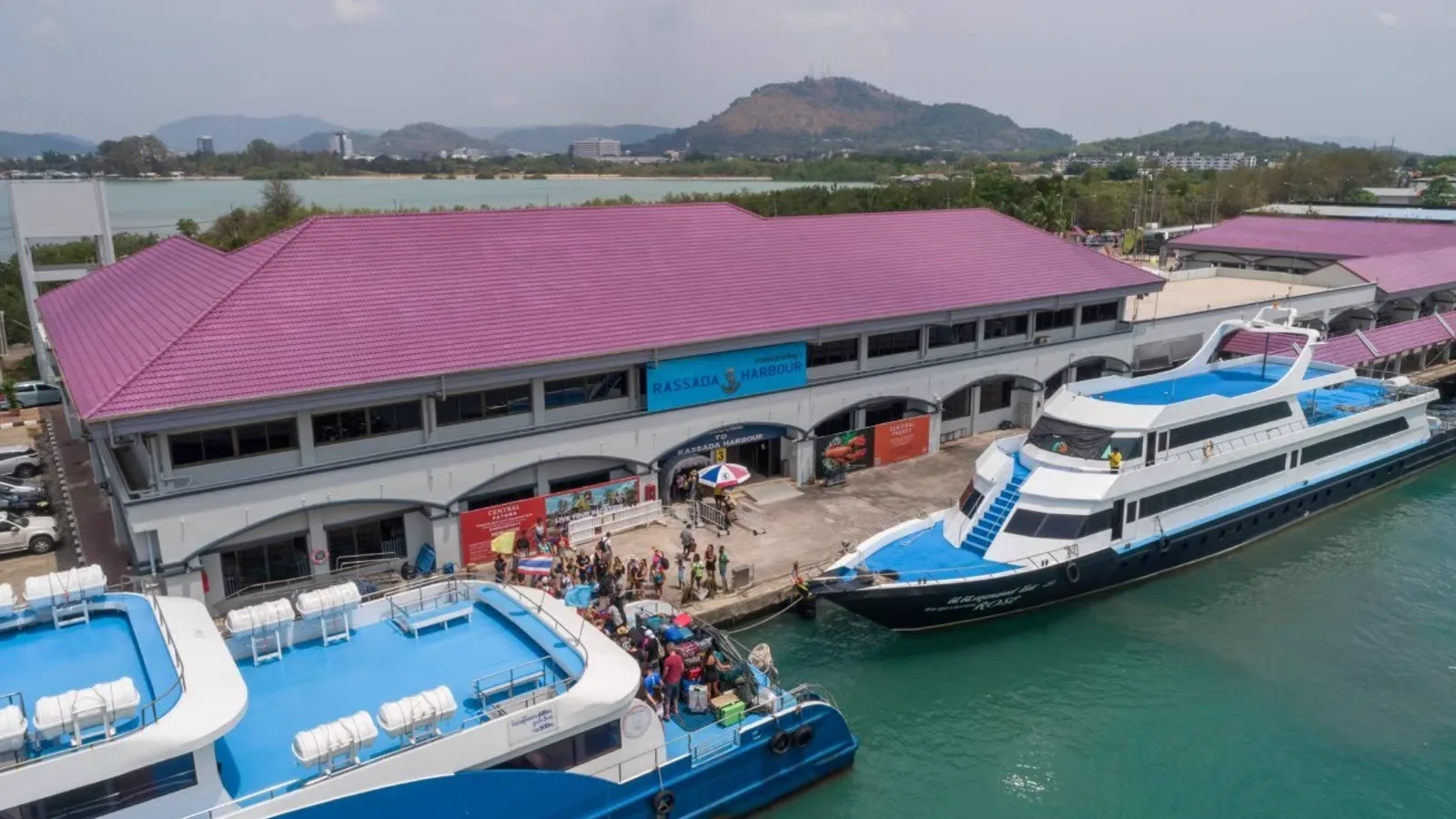
Rassada Pier is not beside Phuket International Airport. The airport process, road transfer and pier check-in are three separate clocks. Your buffer needs to absorb at least one of them running badly without turning the trip into a sprint.
Use this buffer before you buy the boat
Use this only when the flight is on one ticket, you are comfortable taking a direct car to the pier and missing the boat would not wreck a hard onward booking. Around 3.5 hours is calmer.
Immigration and checked-bag timing add variables you cannot control. Around 4.5 hours gives the connection room to behave like a holiday rather than a relay race.
Those are Do Thailand planning buffers, not ferry-operator guarantees. They are intentionally more conservative than simply adding the advertised drive time to the sailing time.
Andaman Wave Master currently describes the drive from Phuket Airport to Rassada Pier as approximately 60+ minutes depending on traffic. Its live Phuket information identifies Rassada as the island's main ferry terminal for Phi Phi and other Andaman routes. Ao Nang Travel & Tour currently instructs passengers on its Phuket–Phi Phi ferry to check in at Rassada 30 minutes before departure.
That already consumes at least 90 minutes before you count leaving the aircraft, immigration, baggage claim, finding your driver, traffic variation or a queue at the pier.
Keep the road and ferry on one confirmation
Check whether the coordinated transfer fits your real landing time
Compare the live pickup and ferry options only after your arrival buffer passes. Match the airport terminal, sailing time, luggage and Phi Phi arrival pier before paying.
See the current airport-to-Phi Phi transfer for your dateBuild the connection backwards from the pier
The mental shift is simple: your connection starts at the scheduled landing time, but it succeeds at the pier check-in deadline. The middle cannot be treated as empty space.
For a 13:30-ish boat, the flight needs to be much earlier than it looks
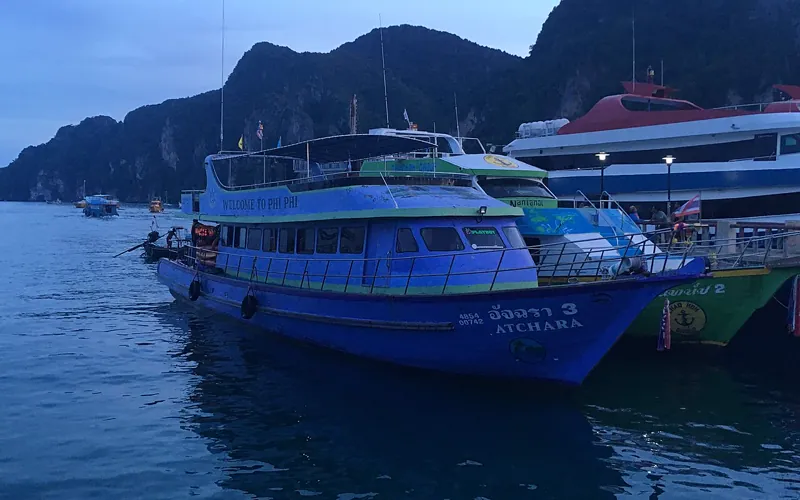
Current Phi Phi inventory is not one universal timetable. Andaman Wave Master currently publishes a Rassada-to-Tonsai ferry at roughly 13:45–15:45, while its live speedboat inventory includes earlier and midday departures. A current GetYourGuide airport-plus-ferry product describes approximately 09:00 and 13:30 Phuket-to-Phi Phi ferry options. Schedules can change, so the exact sailing must be rechecked for your date.
A practical way to read a 13:30–13:45 departure
Domestic flight: I would aim for a scheduled landing by about 10:00. About 10:30 is closer to my minimum threshold, not the comfortable one.
International flight: I would aim for about 09:00. About 09:30 is the edge of my minimum threshold.
If your flight lands later than that, the right question is not “Can Google Maps show an hour to the pier?” It is “What happens if the bag takes 25 minutes longer or traffic stalls?”
There is no medal for making the last boat with four minutes to spare. A same-day connection is only a good transport plan when you can lose some time and still make it.
A domestic arrival is simpler, but checked luggage still owns the clock
For a domestic flight into Phuket, you avoid immigration. That is why the three-hour planning floor can work when the rest of the chain is clean.
If you are choosing between landing in Phuket or Krabi for a wider Andaman trip, the Krabi or Phuket Airport guide starts with the final beach or island rather than the airfare. And if your actual first night is Patong rather than Phi Phi, use the separate Phuket Airport to Patong transport decision; do not force an airport-to-pier strategy onto a hotel arrival.
An international arrival needs a different risk tolerance
Airports of Thailand's current Phuket arrival flow separates international immigration, baggage collection and customs before onward transport. You cannot know in advance how long those stages will take on your flight.
That is why I would not book a Phi Phi boat two-and-a-half hours after an international landing even if a perfect-case calculation appears to fit. A transfer driver cannot shorten an immigration queue, and the ferry will not wait because your aircraft parked late.
For a solo traveler, the extra buffer is useful beyond punctuality. It means you can use the bathroom, buy water, organize your bags and find the correct pickup without making every small task feel like a threat to the boat. That is a much better first hour in Thailand than running through an unfamiliar terminal with a suitcase.
My pick
For a domestic arrival with cabin baggage and comfortable slack, I would take a prebooked direct car to Rassada and hold a ferry booking whose check-in rule I have read. For an international arrival, a family carrying several bags, or anyone who wants fewer handoffs, I would first compare a coordinated airport-and-ferry product. If the available pickup window still leaves the connection depending on a perfect immigration queue, I would stay in Phuket and sail the next morning. Coordination can remove messages and mismatched meeting points; it cannot create time that is not on the clock.
Match every leg before checkout
Recheck the pickup window, luggage terms and exact Phi Phi ferry
Open the live option with your travel date, then compare its airport meeting instructions and sailing against the buffer you calculated above. Do not book from the headline alone.
Compare the coordinated transfer against your flightA combined airport + ferry transfer can simplify coordination — not physics
There is a real advantage to booking the road and boat as one coordinated product: fewer separate confirmations, one commercial point of contact and less ambiguity about which pier the driver is taking you to.
But the package does not make an overly tight flight safe. Check the stated pickup process, ferry time, waiting policy if your flight is delayed and what happens if the booked sailing is missed before you pay.
Read the inclusions literally. “Airport transfer” may describe a scheduled pickup rather than a driver who waits indefinitely after a delay. “Ferry to Phi Phi” may end at Tonsai even when your hotel expects a transfer onward to another beach. Save the operator contact and the pier name offline before boarding your flight into Phuket.
The Phuket Town airport bus is good public transport — and the wrong tool for a tight ferry
Airports of Thailand currently lists Airport Bus Phuket route 8411 for Phuket Airport → Phuket Town. That is useful when Phuket Town is where you are actually going.
Rassada Pier is near Phuket Town, but “near” is not “the bus drops you at your ferry check-in.” Using 8411 for a tight same-day boat creates an extra handoff from the town bus to another vehicle for the pier. When your departure time is fixed, that is exactly the kind of connection I would pay to remove.
If you are staying in Phuket overnight, the calculation changes. Public transport can be completely sensible because the boat is tomorrow's problem, not the next 90 minutes. The Phuket stay guide is the better place to decide whether your overnight base belongs in Patong, Kata, Kamala or elsewhere.
Choose the airport ride for this deadline, not for your whole trip
A direct car is the sensible tool for an airport-to-pier connection because it removes stops and transfers. That does not mean every later journey in Phuket should use the same mode. If the airport is actually the start of a beach stay, compare the dedicated Phuket Airport to Bang Tao options or the separate airport-to-Patong route. Those trips have different deadlines and public-transport trade-offs.
If you sleep near Phuket Town and move west after the ferry plan changes, the Old Town to Patong comparison is more useful than trying to reuse the airport plan. Likewise, the island-wide scooter versus Grab decision belongs to the repeated journeys of a stay, not a one-off sprint with luggage to a ferry. A wet backpack, a suitcase and a fixed sailing are a poor moment to experiment with self-drive.
The same principle applies after a Patong night. Use the Patong to Karon or Kata transport guide when the beach move is flexible. A route can be perfectly acceptable for a hotel change and still be the wrong choice before a boat that closes check-in without you.
Luggage changes the connection more than people expect
A roller suitcase is manageable at an airport. At a pier, the useful question is whether you can control it while also holding your phone, ticket and valuables during check-in and boarding.
Keep passport, phone, cash and any medication in a zipped personal bag that stays with you rather than loose in the top of a suitcase. If you are boarding alone, leave one hand free whenever staff are moving luggage or the gangway is wet. A waterproof pouch for electronics is more useful here than a perfectly organized tote.
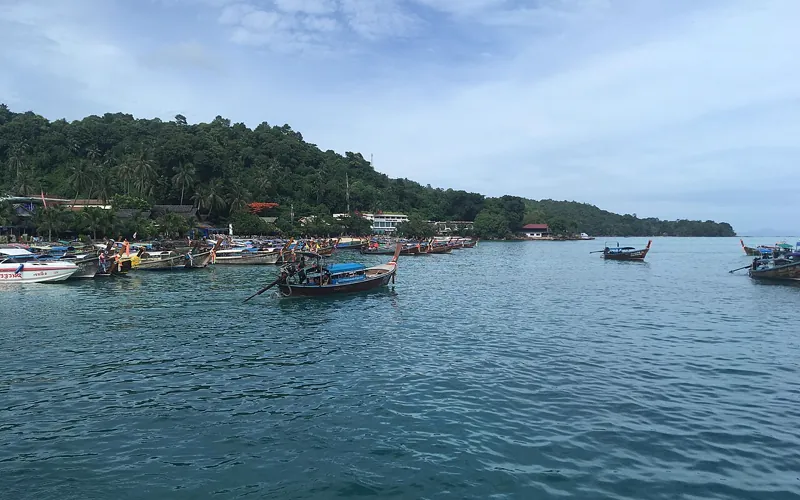
If your Phi Phi accommodation is not near Tonsai Pier, your transport chain continues after the ferry. Laem Tong and other beach areas can involve a different boat arrival or hotel transfer arrangement. Confirm the arrival pier your hotel expects before choosing the Phuket departure; otherwise you can “make the ferry” and still create another awkward transfer at the island end. Save the hotel contact, map pin and arrival instructions offline before the ferry leaves; mobile reception is not the right place to discover that the property is on another beach.
Weather is a separate failure mode
Airport buffer protects you from airport and road delays. It does not protect the sailing from sea conditions.
Thailand's Meteorological Department publishes dedicated shipping forecasts for the Andaman Sea. Recent 2026 advisories have included periods of strong wind and waves around Phuket and the upper Andaman Sea, with small-boat restrictions during the roughest conditions. Operators can change or suspend services when conditions demand it.
That matters most when someone tries to rescue a missed ferry by buying the first speedboat they can find. A faster boat is not a loophole around unsafe sea conditions. If the operator changes the schedule or staff advise against sailing, treat that as a hard transport constraint.
This same weather logic applies farther along the Andaman coast. If your trip continues into Krabi, the Krabi destination guide, Krabi Airport to Ao Nang guide and Railay East vs West stay guide help separate road, boat and hotel-location decisions instead of stacking them into one fragile chain.
When I would deliberately sleep in Phuket instead
I would add a Phuket night before Phi Phi when any two of these are true:
- Your international flight lands after the comfortable window for the last useful boat.
- You have checked luggage and no later sailing you are happy to use.
- Your flight is on a separate ticket after another connection and a delay would not be protected.
- You are traveling in a monsoon period when marine schedules deserve extra flexibility.
- You arrive after a long overnight flight and the idea of immediately managing road + pier + boat already sounds exhausting.
- You have an expensive Phi Phi hotel night that you would hate to lose because the boat connection failed.
That overnight is not wasted time if it turns three risky transfers into one easy ferry the next morning. Phuket Town can also make sense as a purely logistical night because Rassada is on Phuket's southeast side near the town, but choose it because it solves the connection — not because every Phuket visitor needs to stay there.
If you decide to break the journey, browse the Phuket destination hub and Thailand stay guides before choosing the hotel. The point of the overnight is to reduce friction, so do not pick a property that creates a difficult dawn transfer back across the island.
If the ferry becomes tomorrow, turn the spare time into a coherent plan
Do not react to a missed or cancelled boat by crossing Phuket repeatedly. Choose one base and one useful block. If you want a beach night, compare Kata versus Karon by evening walkability, then use the finer Kata Yai versus Kata Noi choice only if you already know Kata is the right side of the island for you. If the next boat is early, however, a far-west beach can create the same pre-departure crossing you were trying to avoid.
Phuket Town is the cleaner logistical fallback near Rassada. A Sunday arrival can pair naturally with the Old Town Sunday market decision; on another evening, keep the walk shorter and eat near the hotel. For a broader menu that does not pretend every attraction fits one spare day, use the things-to-do-in-Phuket guide and filter it by where you are already sleeping.
Rain does not require a cross-island rescue mission. If you have a long indoor block, check whether Aquaria Phuket is worth the time. If the sea cancellation gives you a genuinely free full day rather than a few leftover hours, Andamanda Phuket can make sense, but only when storing luggage and returning for an early ferry will not undo the convenience.
For an evening fallback, choose one venue close to the replacement hotel. The separate decisions for Phuket FantaSea, Simon Cabaret and Siam Niramit Phuket help you choose by location and show format. The right backup is not the most famous option; it is the one that still leaves tomorrow morning's pier transfer easy.
The rule to remember
Domestic landing: start at three hours. International landing: start at four. Add another 30 minutes when the boat is the last useful departure, you have checked bags, you dislike rushed connections, or missing it would cost you a hotel night.
Then work backwards: pier check-in, road time, airport exit. If one ordinary delay breaks the connection, it is not a good connection.
For more route decisions, use the Thailand transport hub or browse all Do Thailand guides.
Operational sources checked 23 August 2026: Airports of Thailand — Phuket arrival flow and ground transport; Andaman Wave Master — Phuket/Rassada Pier information; Andaman Wave Master — Phuket to Phi Phi ferry timetable; Ao Nang Travel & Tour — Rassada to Phi Phi check-in guidance; Thai Meteorological Department — shipping weather.