

Phuket Old Town and Patong are close enough on the map to tempt you into treating this as a routine taxi trip. They are also connected by a current public-bus route that is much more useful than many older Phuket transport guides suggest.
As of 23 August 2026, Phuket Smart Bus publishes Route 2 between Bus Terminal 2, Bus Terminal 1, Phuket Town, Samkong, Kathu and Patong, with a 50-baht flat fare. That makes the bus a credible first choice for a planned day or sunset transfer. The trade-off is not mainly speed. It is how much control you want over the pickup point, the return time and the final walk.
Use Route 2
You have a small day bag, can walk comfortably to a current stop, are not under a reservation deadline and can check the live bus tracker before leaving.
Use Grab
You have luggage, a hotel-to-hotel move, rain, a late return, an awkward Patong entrance or a time-sensitive dinner, show or onward connection.
First, correct one easy mistake: you do not automatically need Bus Terminal 2
Route 2 is published as the Bus Terminal–Patong service, but its own route description shows that it continues through Bus Terminal 1 and Phuket Town before crossing via Samkong and Kathu to Patong. If you are already staying or sightseeing in Old Town, do not assume you must backtrack to Bus Terminal 2 just because it appears at the start of the route name.
Phuket Smart Bus separately operates the Dragon Line, a free city loop serving Old Town landmarks. That is not the Patong service. Think of the two routes as different tools: Dragon Line helps with movement around the city centre; Route 2 is the cross-island link to Patong.
If you are choosing where to base yourself rather than making a day trip, start with where to stay in Phuket. A transport comparison cannot fix a hotel pin that repeatedly puts you on the wrong side of the island for the trip you want.
Map the real walk at both ends before choosing the bus
“Old Town” is an area, not one pickup pin. Route 2's official corridor passes Phuket Town and the bus terminals, while the operator's own Old Town guide describes the terminal as a walk from the historic streets. If you are starting near Thalang Road, Soi Romanee or a café deep inside the heritage grid, count that walk before calling the journey direct. The separate Old Town weekday or Sunday-market guide helps you decide where your visit will actually finish.
Do the same at Patong. A beach arrival is excellent for sand, sunset and the central seafront, but it is not automatically door-to-door for every resort. A property on a steep approach, toward the quieter edges of the bay or behind a large road can turn the final walk into the hardest part of the transfer. Pin the stop and your exact destination on the same map before you decide that the lower fare wins.
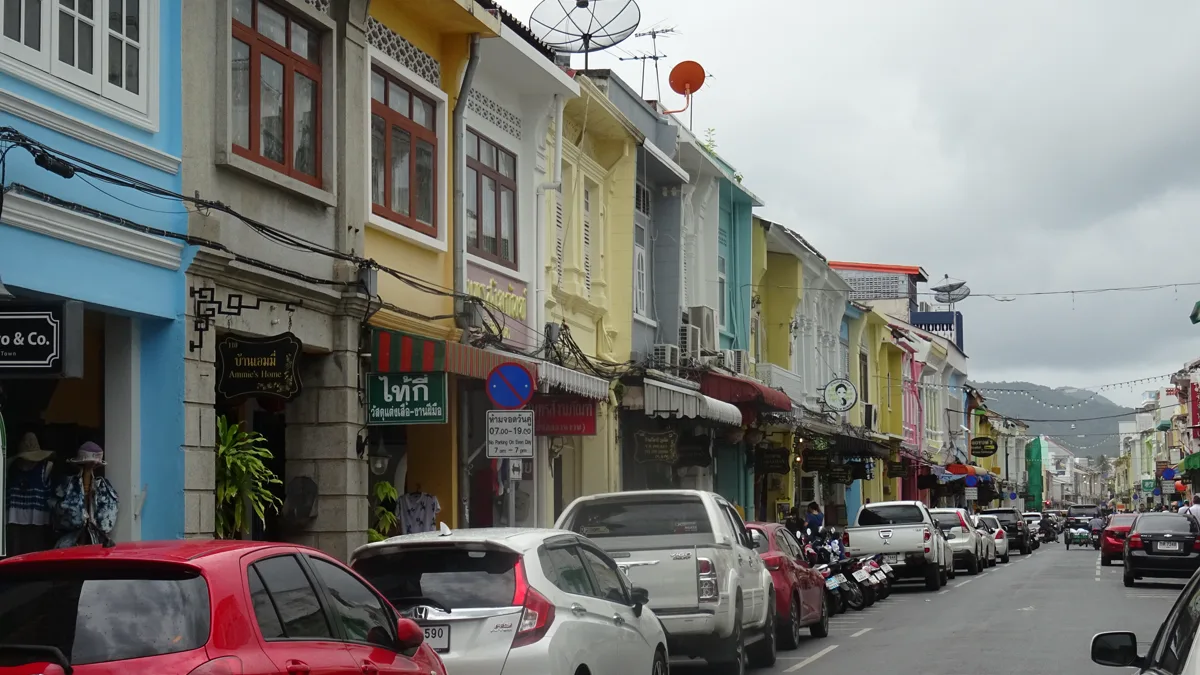

The bus works best when the outward journey is the predictable half of the day
One of the strongest Route 2 use cases is surprisingly specific: Old Town in the morning or afternoon, Patong for sunset and early evening. Phuket Smart Bus currently recommends Phuket Town departures at 16:00, 16:30 and 17:00 for travelers heading to Patong for sunset. The operator also warns that timetable times are approximate and may move with traffic.
That combination tells you how to use the service well. Treat the timetable as a planning window, then check the live bus position before you commit to leaving the café, museum or hotel. This is better than standing roadside far in advance because a screenshot says a bus should arrive at a particular minute.
This is also why Route 2 should not be confused with the west-coast Route 1 used in the Patong to Karon or Kata Smart Bus comparison. Route 1 runs along the beach corridor. Route 2 is the town-to-Patong cross-island connection.
The real comparison is one bus ride versus two exact pins
A Grab trip buys something the bus cannot: the ability to define the exact door at both ends. Grab's current Thailand transport service lets you enter pickup and destination pins and shows an upfront fare for car services before booking, excluding any stated tolls or surcharges.
That does not mean Grab always saves much road time. Both the bus and the car still have to cross between Phuket Town and Patong, and both can be affected by congestion. What the car removes is walking + roadside waiting + the final Patong handoff.
| Your trip | Better default | Why |
|---|---|---|
| Solo, daylight, small bag, flexible beach afternoon | Route 2 | The 50-baht flat fare and direct town-to-Patong route are genuinely useful when both ends fit the stops. |
| Two friends with a fixed dinner booking | Check Grab | Compare the live whole-car quote with two bus fares and value the exact arrival time you need. |
| Moving from an Old Town hotel to a Patong hotel | Grab | A suitcase turns each stop-to-door walk into part of the transport cost. |
| Old Town → Patong for sunset, flexible evening | Route 2 out, Grab back | The scheduled outward trip is easy to plan; the return can stay spontaneous. |
| Heavy rain or wet streets | Grab | The value is mostly in removing exposed waiting and walking, not in making Phuket traffic disappear. |
With luggage, stop comparing fares and count handoffs instead
A day bag and a rolling suitcase create different versions of exactly the same route. If this is a hotel change, the bus journey may contain four physical stages: leave the Old Town hotel, reach the stop, ride Route 2, then walk or arrange another short ride from Patong to the new hotel.
That is still reasonable if both hotels are genuinely stop-side. It becomes false economy if the Patong property is up a hill, deep on a side road or far enough from the useful bus corridor that you need another car anyway.
If your next move is actually to the airport, use the separate Phuket Airport to Patong guide rather than reversing this article. Airport travel has baggage, check-in and departure-buffer consequences that a local Old Town day trip does not.
For a solo woman, daylight bus travel can be the lower-effort choice
There is nothing inherently more independent about ordering a private car for every Phuket journey. In daylight, a known public route with live vehicle tracking can be calmer than negotiating each trip from scratch. You know the corridor, you can see the operator's current bus position, and you can make the decision before stepping outside.
The calculation changes later at night. If you leave Patong after dinner, drinks or a show, the issue is less the label on the transport and more the waiting environment. A poorly lit roadside wait, wet pavement, a low phone battery or a long walk from the drop-off to an Old Town hotel are all good reasons to choose an exact app pickup.
When using Grab, set the pickup pin somewhere the driver can actually stop. If you are inside a hotel, shopping centre or busy venue, you can often wait in a brighter, more comfortable place until the app shows the car approaching rather than standing at the road for the entire wait.
If you are considering solving Phuket's local-transport friction by renting a motorbike, read Phuket scooter vs Grab first. A cross-island hill road, rain or late return is not the right place to discover that a rental scooter does not match your actual licence or riding experience.
Route 2 is unusually good for one-way flexibility
The best way to use Phuket public transport is not to force the return journey to mirror the outward one. If the bus is convenient at 15:30, take it. If the evening evolves and a car is easier at 21:30, use a car. You have not failed to optimize anything.
This is especially useful for travelers staying around Phuket Town who want one Patong evening without committing the whole holiday to Patong. It also works in reverse for a Patong traveler who wants Old Town cafés, museums and the Sunday evening atmosphere but does not want to rent a scooter.
If your wider Phuket decision is about choosing a west-coast base, compare Kata vs Karon, Bang Tao vs Kamala and Laguna Phuket vs Cherng Talay. Those pages deal with the repeated daily transport cost of a base, which matters more than optimizing one isolated ride.
Build the return around what you are doing in Patong
A sunset stroll and an open-ended show night should not use the same return plan. If you only want the beach and an early meal, check the live bus before sitting down and keep the stop within a comfortable walk. If Patong is the start of a later evening, accept from the beginning that a car home may be the sensible half of the journey. That keeps you from cutting dinner short to defend a cheap outward fare.
The same rule applies when the activity has a hard end time. Anyone pairing Patong with the Carnival Magic evening experience should solve the venue transfer separately instead of assuming Route 2 will deliver every final leg. For a rainy daytime plan, the Aquaria Phuket decision guide may keep you around Phuket Town rather than forcing a wet cross-island ride. And if the real plan is a full water-park day, use the Andamanda Phuket guide to place that journey on its own terms.
Keep enough battery for the live tracker, your hotel pin and a backup car request. Save the hotel name in Thai or keep a map pin available offline. This is a small preparation, but it matters after rain, when a busy pickup zone makes text descriptions less useful than a precise location.
What to do when the live bus is not where you expected
Do not read an approximate timetable as a promise that the bus will appear at your stop on an exact minute. First check the live tracker and make sure you are watching the correct direction. If the vehicle is clearly moving toward you, keep the public plan. If the tracker is unclear, the weather is worsening or waiting would jeopardize a reservation, set a deadline for switching to a car instead of repeatedly extending the roadside wait.
A flexible sightseeing day can absorb uncertainty better than a ticketed evening. If transport reliability has become the main constraint, choose another stop or activity from the Phuket and Thailand experience guides rather than crossing the island purely because the original plan said Patong. The aim is not to prove that one mode always wins; it is to protect the part of the day you actually care about.
What the 50-baht fare does — and does not — tell you
The current official timetable publishes Route 2 at 50 baht flat fare. For a solo traveler making one direct ride, that is a strong public-transport case. For two, three or four travelers, do not multiply the bus fare and automatically conclude either mode wins. Open the live app quote and compare the total trip you are actually buying.
A group car becomes more attractive when it also removes a second short ride, a luggage drag or a difficult hotel entrance. The bus remains attractive when everyone can walk easily to both stops and no one has to reorganize the day around a precise arrival.
Check live information before you leave
Route 2 is current, but Phuket traffic and operating details can change. Use the operator's live pages on the day rather than an old screenshot saved from a blog post.
Check the current Phuket Smart Bus timetable →
Open Phuket Smart Bus live tracking →
My pick
If the purpose of the day is simply to get from Old Town to Patong, Route 2 is now easy to recommend whenever the stops and timing fit. If the purpose is a restaurant booking, a hotel move, a late night or a rain-proof evening, the ride is only one component of the plan — and that is where Grab starts earning its extra cost.
My default is Route 2 out in daylight and a fresh decision for the return. That preserves the bus's real advantage without letting a timetable control the whole evening. I would choose a car from the start for luggage, a hotel change, heavy rain, a fixed reservation or any Patong pin that sits awkwardly beyond the useful stop.
For onward island travel, do not carry this local logic into a ferry connection. Read the Phuket Airport to Rassada Pier buffer guide when a Phi Phi departure is at stake, or the Krabi or Phuket Airport comparison when you are still choosing the gateway. Missed boats and flights deserve more slack than an afternoon beach transfer.
If the journey is part of a more active Phuket day, compare the pickup and return demands in the Hanuman World Phuket guide before reusing this city-to-beach logic. Attraction transfers and ordinary public stops solve different problems.
More Phuket decisions
Bottom line: use Route 2 when you can name the stop and the approximate time you want to travel. Use Grab when the important part of the plan is what happens immediately before or after the ride.
Continue with the Phuket destination guides or browse the full Thailand transport hub.
Source check, 23 August 2026: Phuket Smart Bus official timetable, three-route overview, Old Town transport guide, Route 2 evening guidance and live-tracking information; Grab Thailand official JustGrab and GrabCar pages. Check live operator information again on your travel day.