
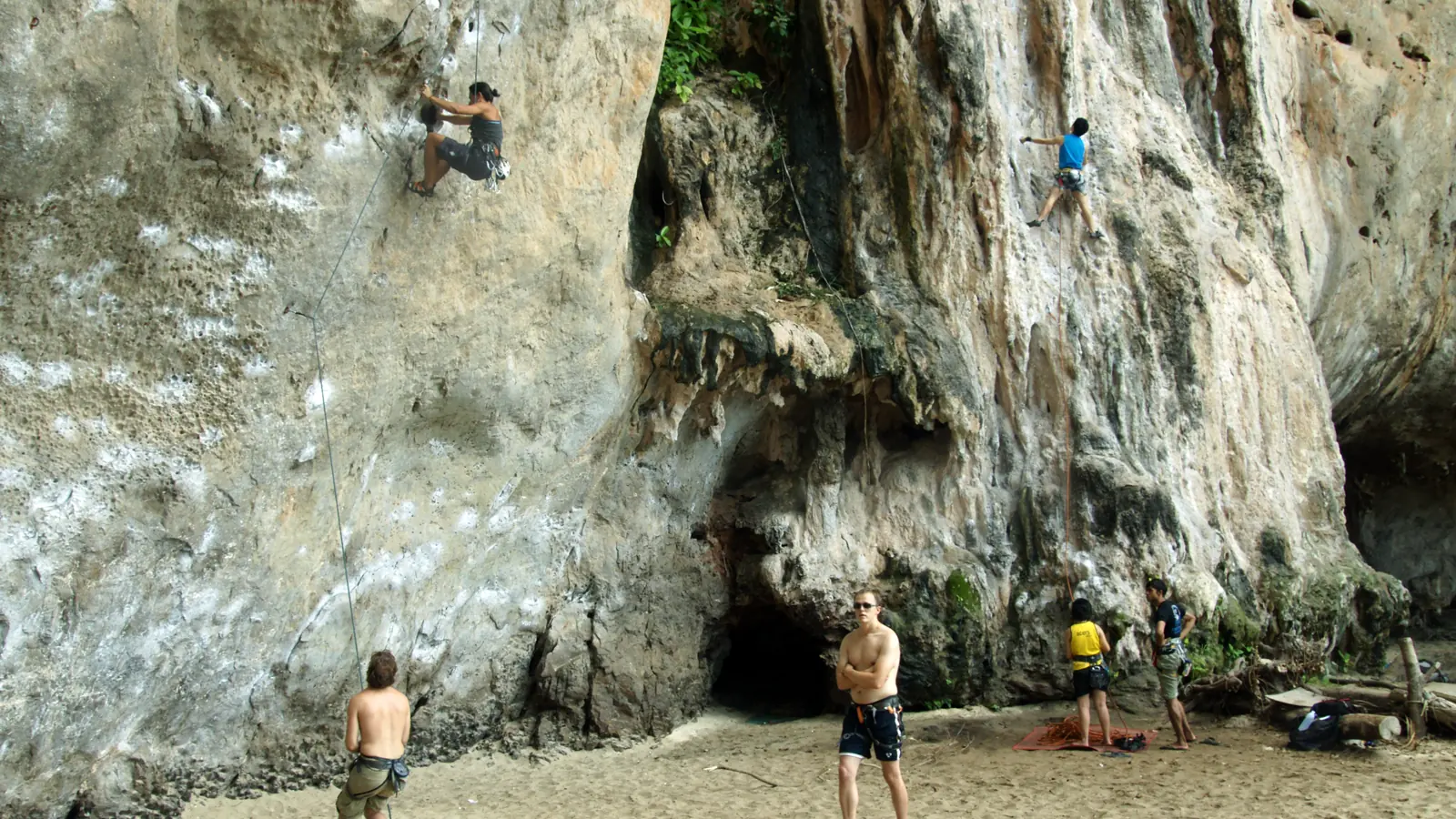
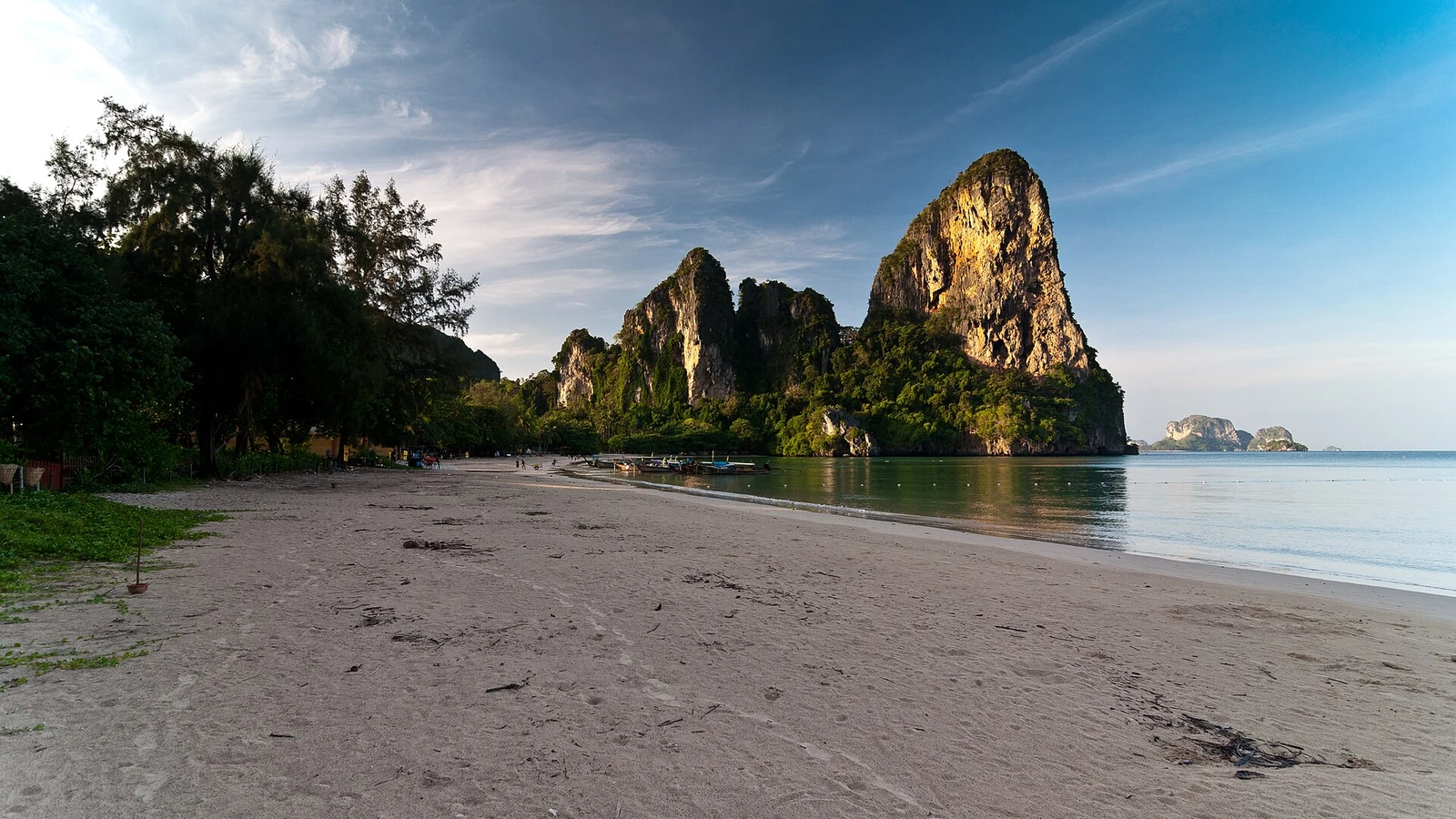
Railay is one of the rare Krabi experiences where the setting can make a beginner overbook. Limestone cliffs rise directly behind the beaches, Tourism Authority of Thailand highlights Railay as an internationally recognised climbing area, and a full day sounds like the proper way to do it. But the better decision is not “more is better.” It is whether you want climbing to occupy one part of the day or become the day itself.
This guide assumes you have already decided to climb. If the bigger question is whether to sleep on the peninsula, start with Ao Nang vs Railay. If you are staying over, the one-night vs two-night Railay guide is the more useful planning step before you lock a long activity into the middle of the stay.
Compare the session you can realistically enjoy
Match the listing to your available half-day or full day, then check the meeting point, pickup zone, group format, climbing time, cave or abseil elements, included equipment and meal terms. A longer listing is only better when its actual schedule matches the day you want.
Make climbing the highlight, not the whole schedule
Best for first-timers, mixed-interest couples or friends, short Railay stays, and anyone who still wants a proper beach, lunch, pool or sunset block on the same day.
Make climbing the purpose of the day
Best when you already know you enjoy climbing, want more repetitions and coaching, or intentionally choose a product that combines climbing with caving, trekking or abseiling.
The decision is an energy budget, not a price upgrade
A half-day Railay climb is not a “lite” sightseeing version. Current GetYourGuide inventory includes four-hour morning and afternoon introductory sessions, while Real Rocks currently describes its half-day group course as suitable for complete beginners as well as climbers who simply want to get onto Railay limestone. That is enough time for the activity to feel substantial without requiring your body and attention for the entire day.
Full-day formats are more varied. Real Rocks currently sells a full-day group climbing, caving and abseiling adventure that also includes light trekking. Its private full-day option is positioned differently: more time with your own guide, with route choice and difficulty adjusted subject to the guide’s approval. A current GetYourGuide full-day course is listed at roughly a full-day duration and focuses on climbing, rappelling and safety instruction.
So do not compare only the labels. Compare what you will actually be doing between breakfast and the return to your hotel.
Use this five-signal test
- You have never climbed outdoors: default to half-day.
- You already climb indoors and want Railay routes to be a serious part of the trip: full-day becomes much easier to justify.
- Your partner or friend is less excited than you are: half-day protects the rest of the day for something you both want.
- You specifically want caving or abseiling as well as climbing: inspect the full-day itinerary instead of assuming every full-day product includes the same extras.
- You only have one Railay overnight: half-day is usually the cleaner fit; a full day can consume nearly all of your luggage-free time.
Why half-day is the better first booking for most beginners
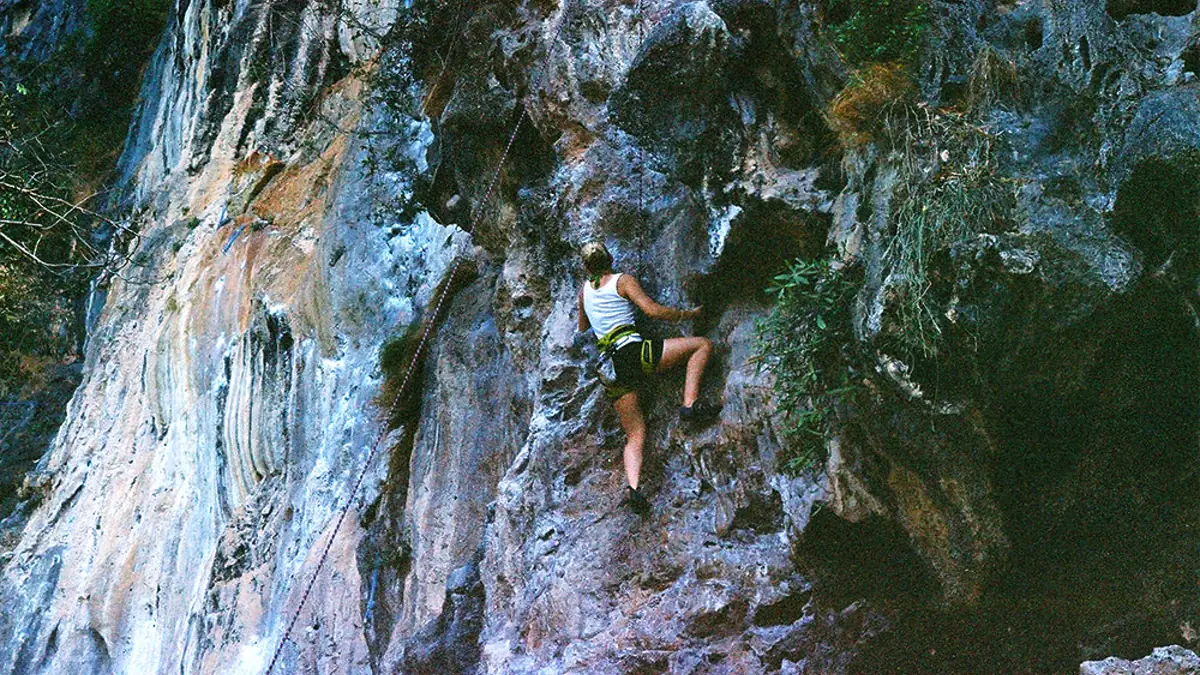
Outdoor climbing is mentally busy even before fatigue becomes the issue. You are learning commands, trusting a harness and rope system, listening to foot-placement advice and adapting to real rock rather than coloured gym holds. More hours do not necessarily create more enjoyment once your forearms, attention or confidence start fading.
A half-day also leaves space for Railay itself. If you choose a morning session, the afternoon can still belong to Phra Nang, a long lunch, a shower and a sunset walk. If you choose an afternoon session, you can keep the morning slow and avoid turning the day into an alarm-clock race. Current half-day products are available in both morning and afternoon formats, although exact start times and pickup arrangements should be checked on your booking date.
This is especially sensible if Railay is only one component of a broader Krabi trip. You may also be choosing a Hong Islands boat format or deciding between a Four Islands day and sunset tour. Stacking a full climbing day beside several boat days can make the itinerary feel physically repetitive even though the scenery changes.
What a beginner half-day actually feels like
The advertised duration is not continuous time pulling on the wall. A responsible introductory session has a sequence: meet the guide, fit the harness and shoes, learn the safety commands, watch the rope system, walk to the chosen sector, and take turns climbing while other group members belay or wait. That is not wasted time. Those pauses are part of learning how an outdoor climbing session works and give your forearms and feet a chance to recover before another route.
Most beginners get more value from several well-chosen attempts than from chasing a high route count. Your first climb may be dominated by grip and nerves. On the next, you begin to trust your feet. Later, you may understand why the guide keeps asking you to straighten your arms or move your hips closer to the wall. The useful progression is confidence and movement, not a promise that everyone will finish the same number of routes.
A morning session also pairs naturally with an independent afternoon on the water. If your hands and shoulders still feel fresh, compare independent and guided Railay kayaking. If they do not, a beach, meal and slow walk is the better decision. Do not build the afternoon as though climbing creates no fatigue.
When a full day actually earns the extra commitment
Choose the full day because the extra time changes what you can learn or do, not because it sounds more complete.
| Your reason | Half-day response | Full-day response |
|---|---|---|
| “I just want to try Railay climbing once.” | Usually enough. You get a real session without giving up the whole day. | Often more commitment than the question requires. |
| “I climb at home and want time on real limestone.” | Useful taster, but it may end just as you settle in. | Stronger fit, especially with a private guide or a route-focused format. |
| “I want climbing plus cave or abseil elements.” | Only if the exact half-day product includes them. | Potentially ideal, but read the itinerary because inclusions vary. |
| “I still want a beach afternoon and relaxed dinner.” | Clear winner. | The rest of Railay becomes recovery time rather than another plan. |
| “This is the activity I am most excited about in Krabi.” | May feel too short. | Worth considering. |
Do not assume “full-day” means eight hours on the wall
This is the most important booking-detail check. Operators package full-day climbing differently. Real Rocks’ current group full-day is a mixed climbing, caving, light-trekking and abseiling day. Its private course is more explicitly about practising and developing climbing skills with a private guide. A separate current GetYourGuide full-day product describes multiple climbing locations, instruction and rappelling.
If what you really want is maximum climbing time, ask what percentage of the day is expected to be on the rock and how the group is organised. If what you want is variety, a mixed adventure day may be exactly why the full-day version is better.
Also check food. Real Rocks currently includes guide services, climbing equipment, individual accident insurance and bottled water on its climbing trips, but states that meals are not included. Other products can package things differently. “Full-day” is a duration label, not a promise that lunch, transfers or every activity you saw in another listing will be included.
Guide attention can matter more than course length
Real Rocks currently states a maximum of three or four climbers per guide for its group course. That ratio is useful context, but you should still ask how your exact session handles mixed ability. A small group can move efficiently when everyone is a beginner with similar confidence. It can feel slower when one guest needs repeated reassurance and another has enough experience to request harder routes. Neither guest is doing anything wrong; they simply need different coaching.
If you already climb, a private half-day with purposeful route selection may deliver more useful movement time than a full-day general group adventure. If you are completely new, a calm group half-day can be better value because you learn by watching other climbers as well as by climbing yourself. Ask about the guide ratio, the likely ability mix and whether route choice is adjusted on the day. Do not assume a private booking allows you to override safety decisions or weather-led route changes.
Included shoes and equipment: what to check before pickup
Current courses typically include the essential climbing equipment, but “equipment included” does not answer every comfort question. Confirm that climbing shoes, harness and helmet are included in your chosen option, then provide an accurate shoe size if the booking flow asks for it. Rental climbing shoes are meant to fit closely, but pain, numbness or a crushed toe is not a badge of commitment. Tell the guide if the fit feels wrong before walking to the wall.
Bring only the personal items the operator recommends: water if it is not included, sun protection for the walk and waiting periods, and a dry layer for the return. Your hands need to be free and your bag may sit away from you while you climb. If the day is part of a longer transfer sequence, solve the luggage problem first through the operator or hotel rather than arriving at the meeting point with a suitcase.
Your hotel base changes the day more than beginners expect
If you are already sleeping in Railay, a climbing day is logistically simple: you are starting where the activity happens. The bigger decision is whether that activity should use the full middle day of the stay. This is where Railay East vs West matters less than the exact operator meeting point and more than whether you want beach time before or after the session.
If you stay in Ao Nang, current Real Rocks terms include round-trip transfer to Railay for Ao Nang hotels on its climbing trips, while transfers from Krabi Town, Klong Muang and Tubkaek can require additional arrangements or charges. Other operators set their own pickup zones. That makes your exact Ao Nang hotel location less important than confirming the pickup instructions, but it does make remote resort bases worth checking before payment.
The transfer belongs inside the activity duration even when the listing headline focuses on climbing. A mainland guest may have a hotel pickup, road transfer, boat connection, equipment fit and approach walk before touching the wall. A Railay guest may meet much closer to the climbing area. That difference is why a session of the same advertised length can occupy different amounts of usable holiday time. If you are arriving that day, compare the Ao Nam Mao and Ao Nang routes into Railay; do not place a climbing pickup against an optimistic flight arrival.
If you are choosing between quieter northern beaches, read Klong Muang vs Ao Nang and Tubkaek vs Klong Muang as hotel decisions first. Do not move resorts purely to simplify one climbing pickup unless climbing is central to the trip.
Travellers sleeping in Ao Nang can also use the airport-to-Ao Nang transfer comparison to protect the first night from a bad connection. If your hotel shortlist includes Ao Nam Mao, settle Ao Nam Mao vs Ao Nang as a whole-trip decision, not merely as a way to shorten one morning’s boat connection.
Morning or afternoon? Treat that as a second decision
Weather can change the equation. Real Rocks’ current seasonal guidance notes that some overhanging Railay routes can remain climbable during wetter months, but conditions can be more slippery and change quickly. That is not a reason to self-assess whether a route is safe. Follow the guide’s route choice, delay or cancellation decision on the day.
Practical details that matter more when you are climbing, not sightseeing
- Wear something that works under a harness. Secure pockets and close-fitting athletic clothing are easier than loose beach cover-ups. Bring a dry top for after the session.
- Keep valuables minimal. If your day includes a mainland transfer and longtail boat, a small waterproof pouch for phone, passport and payment cards is easier to manage than a large beach bag.
- Ask about bathroom and changing timing. Do not assume the climbing location itself has the same facilities as your hotel. Change before pickup when possible.
- Leave rings and delicate jewellery at the hotel. Rock, rope and harness time are not a useful place for them.
- Do not schedule a polished evening immediately after a full day. A shower, food and a quiet dinner is the more realistic finish if you have spent most of the day climbing, walking and moving in tropical heat.
A full day is not automatically better for couples or friends
If both of you climb and are equally excited, a full day can become one of the trip’s anchor experiences. If one person is curious and the other is merely willing, half-day is kinder to the rest of the relationship and the itinerary. The less enthusiastic person still gets a real experience; the keen climber gets Railay limestone; and neither has surrendered every daylight hour.
For solo travelers, the same logic applies in a different way. Group sessions can provide structure without requiring a travel companion, but confirm the meeting point and return arrangement before the day starts. If you are staying on the mainland, save the operator contact, hotel name and pickup instruction offline. If you are staying in Railay, keep the route back to your hotel simple after an afternoon session rather than adding an unnecessary late transfer.
Build the surrounding Krabi days to recover, not compete
A full climbing day should not sit between two equally demanding starts simply because every experience looks different on a booking screen. If you want an early viewpoint, decide whether Din Daeng Doi sunrise is worth the wake-up and place it away from the climbing day. If you also want Phi Phi, decide between an early-bird and standard Krabi departure before assuming your body will enjoy consecutive early mornings.
A cooking afternoon is usually a gentler contrast than another boat or hike, but the start location still matters. The market-tour vs kitchen-only cooking class guide helps decide whether the activity is a meal, a market lesson or both. For a broader shortlist, use the Krabi things-to-do guide only after protecting the rest block that a full climbing day deserves.
My pick
When the climbing finishes, do you want to feel that you still have a Railay day left?
If yes, choose half-day. It is the stronger default for first-timers, short stays and mixed-interest trips. If no—because climbing itself is the day you came for—choose full-day, then read the itinerary closely enough to know whether you are buying extra route time, a private skill-development session, or a mixed climbing-caving-abseiling adventure.
And if the full-day choice makes your Railay stay feel cramped, do not solve that by rushing harder. Revisit whether Railay deserves two nights, or keep the hotel on the mainland and use the activity as the reason to cross. The cleanest Krabi plans usually come from deciding what deserves the full day before deciding where to sleep around it.
Cross-check the exact session, pickup and inclusions
For a first outdoor climb, favour the focused half-day and choose morning or afternoon around the rest of Railay. Move to a full day only when climbing is the central experience or the cave, trek and abseil sequence is specifically what you want.
Continue planning without overloading the itinerary
If climbing has taken the active slot, use the next decision to reduce friction. Compare whether the Krabi Four Islands tour is worth another boat day, whether a private Four Islands half-day or full day fits your remaining energy, or whether Ao Thalane kayaking works better in the morning or afternoon creates too much upper-body work beside climbing.