
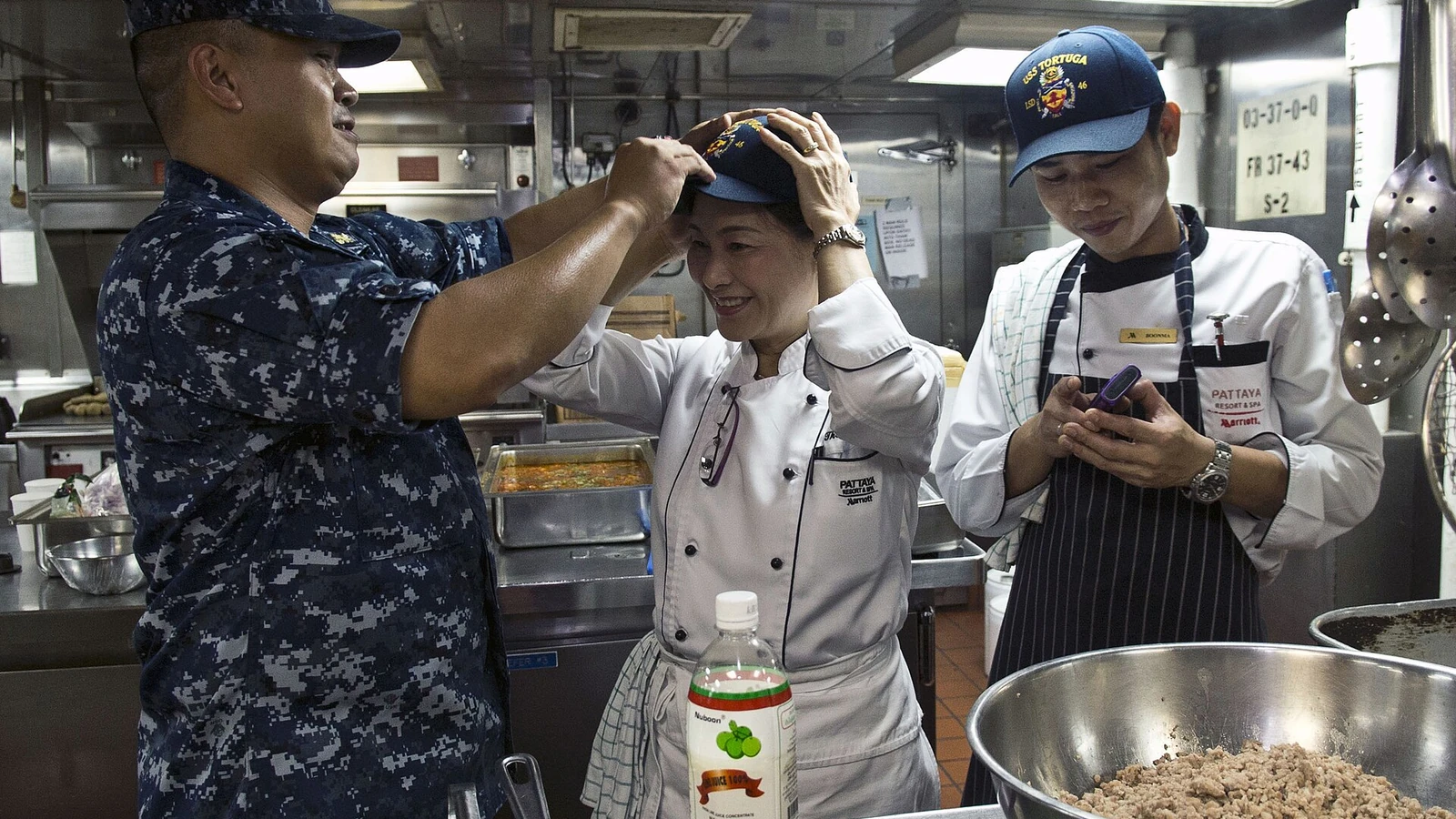
Both formats can teach real Thai cooking. The better question is what you want your extra hour to do. A market stop can make unfamiliar ingredients finally make sense. A kitchen-focused session can spend that same attention on curry paste, knife work, heat control, seasoning and the dishes you will actually try again at home.
You would enjoy learning what to buy, how ingredients differ and what you are looking at before the wok turns on.
You care more about cooking several dishes, adjusting flavor and keeping the session compact.
Then class timing, pickup and your hotel base matter more than whether the market is included.
The market tour earns its place only if you want to learn how Thai food starts
Krabi currently has bookable cooking formats that explicitly include a local market visit and, in some cases, a kitchen-garden stop before the cooking begins. One current GetYourGuide market-format listing in Ao Nang describes a guided local-market visit followed by hands-on preparation at the cooking school; another current listing from the same supplier family combines a market visit with a kitchen garden.
That is valuable if galangal, kaffir lime leaves, Thai basil, pea aubergines, curry-paste ingredients and different kinds of rice are still a blur. Seeing ingredients in context helps explain why Thai recipes do not reduce neatly to a supermarket shopping list.
If you want to ask what can be substituted at home, which ingredient is doing the aromatic work, how produce is selected, or why one chilli is used instead of another, the market stop has a job. If you mostly want colorful photographs before returning to the kitchen, it is easier to overvalue it.
The same logic applies if you have already spent an evening browsing Thai food stalls or a local fresh market. A second market experience can still be interesting, but the marginal value is lower. In that case, a cooking-heavy class may add more to the trip than another guided walk past ingredients you have already discussed.
Want the ingredient story before you cook?
After deciding that the market visit is part of the experience you actually want, check the current pickup area, market component, class duration and dietary notes before booking.
See the current market-tour class →Kitchen-only is not the “basic” option
Krabi has several established cooking schools whose current programmes are built around the kitchen rather than a bundled market walk. Ya’s Cookery School in Ao Nang currently publishes morning, afternoon and evening sessions; its standard formats have students choose dishes, make curry paste from scratch and cook with individual equipment. Aonang Thai Cookery School currently publishes morning, afternoon and dinner sessions with hotel pickup and multiple menu selections. Thai Charm also currently advertises hands-on classes with hotel pickup and a broad choice of dishes.
That can be the better buy when the skill itself is the reason you are going. If you want to leave remembering how a curry paste changes under the pestle, how to balance salty-sour-sweet-spicy flavors, or how quickly a wok dish moves once the heat is on, you do not need a market stop to make the experience substantial.
Market-inclusive class
Best when you want food culture + ingredient recognition + cooking in one block. Expect part of the session to happen away from the stove.
Kitchen-focused class
Best when you want a denser cooking lesson, more attention on the menu, or a shorter experience that fits around beach and boat plans.
For an active Krabi trip, that time difference matters. A morning cooking session can sit beside a relaxed afternoon in Ao Nang; a compact evening class can work after a hotel day. By contrast, trying to wedge a food experience around a Hong Islands boat day or a Four Islands sunset tour can turn a nice class into another clock to chase.
Use the clock before you use the menu
Cooking-school menus are tempting to compare dish by dish, but the session that fits your day cleanly is often the better choice. Current operators in Krabi offer morning, afternoon and evening formats, and those time blocks change how much transport friction you absorb.
Ya’s currently lists an evening programme from 18:00 to 21:00 and morning/afternoon programmes on its official site. Railay Thai Cooking School currently lists separate morning, afternoon and dinner classes for travelers already staying on the peninsula. Those are different products for different trip shapes, not just different start times.
If you are sleeping in Railay, a Railay class can be the lowest-friction version because you avoid leaving the peninsula purely to cook. If you are based on the mainland, crossing by boat simply to attend a cooking class is usually solving a problem you created yourself. Start with Ao Nang vs Railay or Railay East vs West if your accommodation decision is still open.
Your Krabi base changes which class feels easy
This is the simplest base for the broadest choice of cooking-school sessions and hotel pickup. If your trip is activity-heavy, that convenience is one reason central Ao Nang and Nopparat Thara need slightly different treatment.
Do not assume every advertised “Krabi pickup” is identical. Some schools publish extra transfer terms or narrower pickup arrangements. If resort time is the priority, revisit Klong Muang vs Ao Nang or Tubkaek vs Klong Muang before choosing a class that adds unnecessary road time.
Useful for Railay access, but the exact cooking-school transfer rules matter. If you chose the area mainly for repeated boat access, the Ao Nam Mao vs Ao Nang trade-off still applies on a non-boat day.
Choose a Railay-based class if cooking is meant to fit naturally into a Railay stay. The same “usable hours” logic from one night vs two nights in Railay matters here: do not spend a short peninsula stay commuting back to the mainland for an activity you can do locally.
If your cooking class falls on arrival day, be more conservative. Delayed bags, airport queues and a hotel check-in are poor ingredients for a prepaid class. The Krabi Airport to Ao Nang transport decision is straightforward enough, but arrival-day timing still has variance that a fixed cooking-school start does not.
For solo women, the boring logistics are part of the experience
For an evening class, confirm whether the published transfer includes the return to your actual hotel, not just a central drop point. If you are staying down a dark or isolated access road, the last 300 metres matter more at 21:00 than they did when you chose the class at noon.
Cooking classes are generally easy solo activities because the class itself supplies structure: you have an instructor, a defined workspace and other participants. The friction usually sits before and after the session. Save the operator’s contact, know the pickup point, keep enough mobile data for messages and maps, and do not assume “hotel pickup” means the same coverage for every beach area.
Also ask how leftovers are handled. Some current schools explicitly offer takeaway service or allow students to take food away. If you are heading straight out afterward, carrying curry or mango sticky rice around in Krabi heat is not especially useful. A class near your hotel can make more sense than a “better” class that leaves you managing containers for the rest of the evening.
Rain makes cooking more valuable — but it does not make every class interchangeable
A cooking class is one of the cleaner ways to protect a Krabi day from imperfect weather, but there is a difference between “rainy” and “stormy.” A market-inclusive class still includes an outdoor or semi-outdoor movement component. A kitchen-only class concentrates more of the experience under cover.
If your boat schedule is already weather-sensitive, it can be smart to keep the cooking class on a separate day rather than booking it immediately after a long marine excursion. The same fatigue logic that matters in the Emerald Pool and Hot Springs day matters here in a smaller way: an activity can be easy physically but still feel rushed when it is the third commitment of the day.
Cooking is a particularly good “primary plan” on a forecast day you already know you do not want to spend at sea. It is a weaker “backup plan” if you wait until the last minute and assume the exact session you want will still have space.
Already know the market is optional for you?
Compare current Ao Nang and Krabi cooking classes by start time, pickup area, class length and whether the session is fully hands-on. Ignore the headline price until the logistics fit your day.
Compare current cooking-class formats →Do not book by dish count alone
Seven dishes sounds better than four. Five menu choices sound better than three. In practice, the number on the sales page does not tell you how much of each dish you actually prepare yourself, whether everyone follows the same menu, how much time is spent demonstrating, or how much help the instructor provides.
Before paying, check the mechanics instead:
- Hands-on or demonstration? Confirm whether you cook at your own station or mainly watch and assist.
- Individual menu choice or group menu? A wide menu is less useful if the whole class must agree on the same dishes.
- Curry paste from scratch? If that skill matters, verify it explicitly rather than assuming every curry class starts with a mortar and pestle.
- Dietary adaptation? Tell the school about allergies, vegetarian or vegan needs before the pickup vehicle arrives.
- Pickup geography? Ao Nang, Krabi Town, Klong Muang, Tubkaek, Ao Nam Mao and Railay are not one interchangeable pickup zone.
- Return time? Especially for an evening class, know when and where the transfer ends.
The easiest booking rule
If you want to remember ingredients, choose the market-tour class. If you want to remember technique, choose the kitchen-focused class. If you mainly want an easy social activity away from boats and beaches, choose the session with the cleanest hotel pickup and the time slot that leaves the rest of your day intact.
And if the class only fits because you are crossing Krabi twice, moving hotels, or racing back from an island trip, it is the wrong class. Use the Krabi destination hub and Experiences hub to keep the activity attached to the trip you are actually taking.