
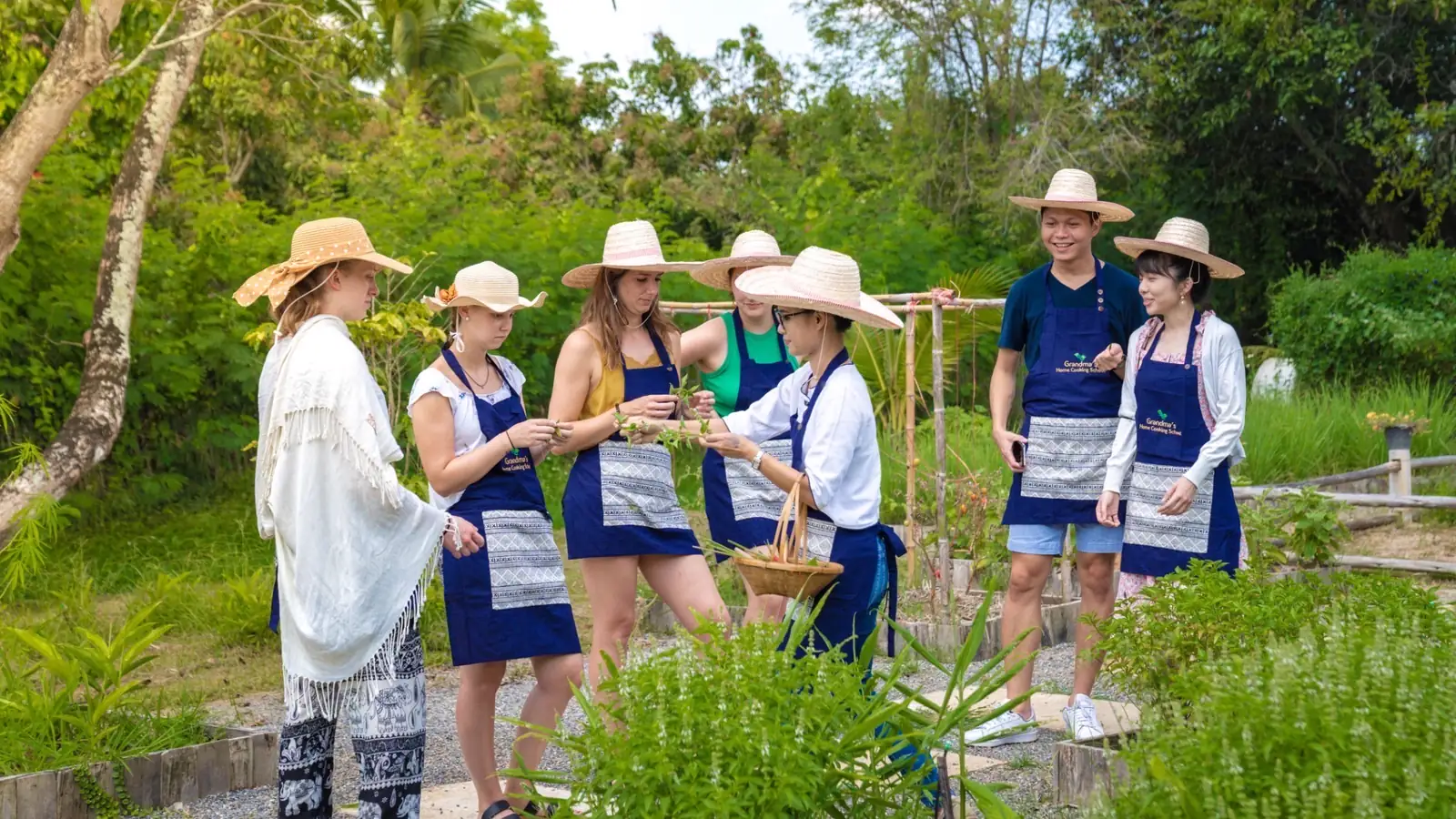
The operator’s current full-day course runs roughly from a hotel pickup around 8:30–9:00 am to a school departure around 3:45–4:00 pm. The morning half-day is back in the city around 2:00–2:30 pm; the afternoon version returns around 4:30–5:00 pm. If you only have four days in Chiang Mai, those recovered hours are big enough to change the whole itinerary.
Choose the session, not the longest label
Compare the live course options against the daylight you keep
Start with the class rhythm you want, then verify the exact session, market visit and hotel pickup available on your date. The booking inventory does not always show every course listed by the school.
Start with the four sessions, because “half-day” is not one product
Grandma’s current official schedule is unusually useful because it makes the trade-off visible. The morning and afternoon half-day sessions include a local-market visit and farm tour. The evening half-day does not include the market. The full-day adds more cooking and a traditional coconut-milk step, but it also absorbs most of the useful daytime block.
Best default
Officially listed at about 9:00 am–1:45 pm, with hotel pickup beforehand and a return to the city around 2:00–2:30 pm. You cook four dishes; dessert is served. Market and farm are included.
Best for slow mornings
Officially listed at about noon–4:00 pm, with the city return around 4:30–5:00 pm. It keeps the market and farm but occupies the middle of the day.
Protects daylight
Officially listed at about 4:00–7:45 pm. You cook five dishes and still tour the farm, but the operator explicitly says there is no market visit.
Cooking becomes the day
The current operator page lists roughly 9:00 am–3:45 pm, seven dishes plus a drink, market and farm visits, and traditional coconut-grating for coconut milk.
This immediately changes the usual recommendation. If “I want a Thai cooking class” means you want one memorable food experience without surrendering a whole day, the morning half-day is the cleanest fit. You can still keep a separate afternoon or evening for your own neighbourhood. If course timing matters more than the farm setting, compare it with Thai Akha Kitchen’s morning and evening formats before deciding which food experience belongs in the trip.
What does the full day actually add?
The current full-day schedule is not simply the half-day class with extra waiting. It stretches the cooking sequence: rice, appetizer, soup, curry paste, stir-fry and curry, dessert and refreshments, with a break in the afternoon. The operator also highlights making coconut milk with a traditional coconut grater as a full-day-only feature.
That extra technique matters if you are the kind of traveler who comes home and actually cooks again. More repetitions also give you more chances to understand how Thai dishes are assembled rather than treating each recipe as a one-off performance.
But if your goal is mainly to shop at a local market, see ingredients growing, make a curry paste and learn a few dishes you recognise, the morning half-day already covers the core arc. You are not buying a “less authentic” version simply because the clock is shorter.
The morning half-day works especially well on a mountain-and-city trip
Chiang Mai trips often have one awkward planning problem: Doi Suthep, Chiang Rai and a cooking class all want substantial chunks of time. If you already plan a separate Doi Suthep day or a Chiang Rai transfer/day trip, using a full day for cooking can leave the city itself feeling strangely compressed.
The morning class solves that by ending early enough to leave a genuine second act. You can return to your hotel, shower, rest, and still have a proper evening. On a weekend, decide whether that post-class evening should begin at Wua Lai on Saturday or inside the Old City on Sunday.
The evening half-day is the sleeper option—but only if you accept the missing market
The evening session looks efficient because it protects most of the sightseeing day. That can be excellent if you are staying somewhere with an easy afternoon pickup and do not mind returning after dinner time. It is also a structured evening for a solo traveler: transport, class and meal all have a defined sequence rather than requiring you to invent the night on the fly.
The compromise is explicit on the current operator page: no local-market visit. If your mental picture of a Chiang Mai cooking class includes walking through a market with an instructor explaining herbs, noodles, curry ingredients and produce, choose morning, afternoon or full day instead.
That distinction is easy to miss on an OTA card because all the session names sit under one activity. It is the kind of small inclusion difference that matters more than a generic review score.
One rule before you select a session
If the market visit is part of why you are booking, eliminate the evening class first. If the market is optional but preserving your sightseeing day matters more, the evening session becomes the strongest half-day alternative.
For women traveling solo or with a friend, the pickup window matters more than it sounds
The school’s official site states that hotel pickup and drop-off are included, and its general information says pickup is available within a stated radius of downtown Chiang Mai. The current GetYourGuide listing also shows pickup as included, but its displayed eligibility area is not identical to the operator wording. The practical rule is simple: check your exact hotel pin against the booking option before you pay.
This matters most if your accommodation is farther from the center, such as a resort-style stay. The cooking class exposes exactly why location matters: a “free pickup” only feels free when your property is actually inside the operational area. The wider things-to-do guide for Chiang Mai helps you see whether other out-of-centre activities create the same transport problem.
For two friends, also plan the boring details. Wear something comfortable in heat, choose shoes you are happy to walk around a market and farm in, and do not schedule a tight spa, dinner reservation or airport transfer immediately after the stated return window. Traffic and multi-hotel drop-offs are not a good place to build a five-minute connection.
Dietary requests have to be solved before the van arrives
The current activity information says vegetarian and halal options are available and asks guests to disclose allergies, gluten-free requirements and other dietary needs before the class. Treat that as an advance conversation, not a note you can casually add while everyone is already choosing dishes. Thai cooking frequently uses sauces, pastes and shared ingredient families that are not obvious from an English menu name. A substitute may be possible, but the school needs enough notice to prepare it and to explain what can or cannot remain separate.
If an allergy is severe, ask a concrete question: which sauces, work surfaces and utensils will be used, and can the school meet the level of separation you require? A booking platform saying that dietary needs can be adjusted is not the same as a medical guarantee. If the answer is vague, do not use enthusiasm or a high review score as a substitute for your own risk decision. The half-day versus full-day comparison becomes irrelevant until the ingredient question is settled.
Families should decide who needs an individual station
Current booking guidance distinguishes younger children who join as visitors from participants with their own cooking station. If a child is expected to cook a complete personal set of dishes, check which ticket is required rather than assuming a visitor place includes a second burner, ingredients and full menu. The school’s own course pages also publish a visitor format that includes transport, the farm visit and a meal; the exact live price and age treatment should be confirmed for your date.
This is not only a cost question. A long full-day sequence can be a poor fit for a child who enjoys the farm and first recipe but loses patience through repeated tasting and technique. A morning half-day often gives a family the same market-and-farm story with a more forgiving finish. The full day makes sense when everyone actively wants the cooking repetitions, not when the adults want the longest package and hope the children adapt.
The market visit is an ingredient lesson, not shopping time
The morning, afternoon and full-day schedules place the local market inside a guided sequence before the farm. The useful value is interpretation: seeing herbs, produce, noodles and seasonings while the instructor explains how they will appear later at the cooking station. It is not a free-form market morning where the group waits while each guest shops. If you want time to browse, return to a market separately or keep a walking-street evening available.
That is why the evening class is not automatically inferior. It loses this ingredient-context step, but it can protect an entire daylight block. Choose it knowingly when farm, cooking and dinner are enough. Choose morning or afternoon when the market explanation is one of the reasons you are paying for an instructor rather than following recipes on your own.
The current activity also includes a digital recipe book. Save it before leaving Chiang Mai and add notes while the ingredient substitutions are still fresh in your mind. The useful souvenir is not a perfect photograph of every dish; it is knowing which paste, sauce and technique you can realistically reproduce in your own kitchen.
Do not arrive hungry in the wrong way
You will cook and taste multiple dishes, so this is not the morning to stack a huge hotel buffet on top of an intensive food session. A cooking-class morning is one of the clearest examples of a day when a lighter breakfast can make the paid experience better. Treat the class as the main food block, not something to stack on top of a large buffet and an early café crawl.
The opposite mistake is skipping food entirely and expecting a late lunch. The morning session’s cooking and tasting unfolds across the class, not as one instant meal the moment you arrive. Eat lightly, not heroically.
How the choice changes by Chiang Mai base
If you stay in Nimman, a morning class leaves you with an easy café-and-dinner reset afterward. If you stay around Chang Khlan, an afternoon class can return you close to the evening zone you already want. If the night still needs a fixed activity, use the Chiang Mai Night Safari guide before placing two transport-heavy bookings back to back.
If you arrive late the night before, avoid making the earliest possible pickup your first test of the trip. Use the Chiang Mai airport late-arrival guide to decide whether the first morning should be deliberately slow, then move the class to the afternoon or another day.
Current GetYourGuide availability does not mirror every operator session
The school’s current official site lists morning, afternoon and evening half-day courses plus full-day options. The current GetYourGuide product page, when checked for this guide, surfaced a morning half-day, an evening half-day and a full-day intensive option. That is a reminder to separate the school’s course structure from the sessions an OTA is selling on your exact date.
Use the operator pages to understand what each session means. Use the booking page to confirm what is actually available for your date, pickup location and group. Do not infer that a missing OTA option has been permanently discontinued.
Who should choose the full day?
Choose it if cooking is one of the reasons you came to Chiang Mai, you genuinely enjoy technique and repetition, and you will not resent seeing most of the daylight disappear into one activity. It is especially sensible on a five-night-or-longer stay where giving one day to food does not force temples, mountain time and neighborhood evenings into the remaining scraps.
Skip the full day if you are doing it because the option list looks more generous. “More dishes” is not the same as “better trip.” For a short first visit, the opportunity cost can be a Doi Suthep block, a slow Old City afternoon or simply the unplanned time that makes Chiang Mai enjoyable.
My pick
Pick the morning half-day for the best all-round first-trip fit. It preserves the market and farm, gives you a meaningful cooking session, and returns the afternoon. Pick the afternoon half-day when you want a slow morning. Pick the evening class only when protecting daylight matters more than the market visit. Pick the full day when cooking deserves to be the day.
That avoids buying the longest option just because it looks more complete. The class should fit the Chiang Mai trip you are building, not force every temple, café and neighbourhood evening into the remaining scraps.
Match the live option to your real day
Recheck the market, pickup radius and return before booking
Session inventory changes by date. Confirm the exact duration and what is included, then choose the shortest format that still contains the parts you care about.
Pair this cooking class with
More Chiang Mai decisions
Continue with the Chiang Mai decision hub or browse more Thailand experience comparisons.