
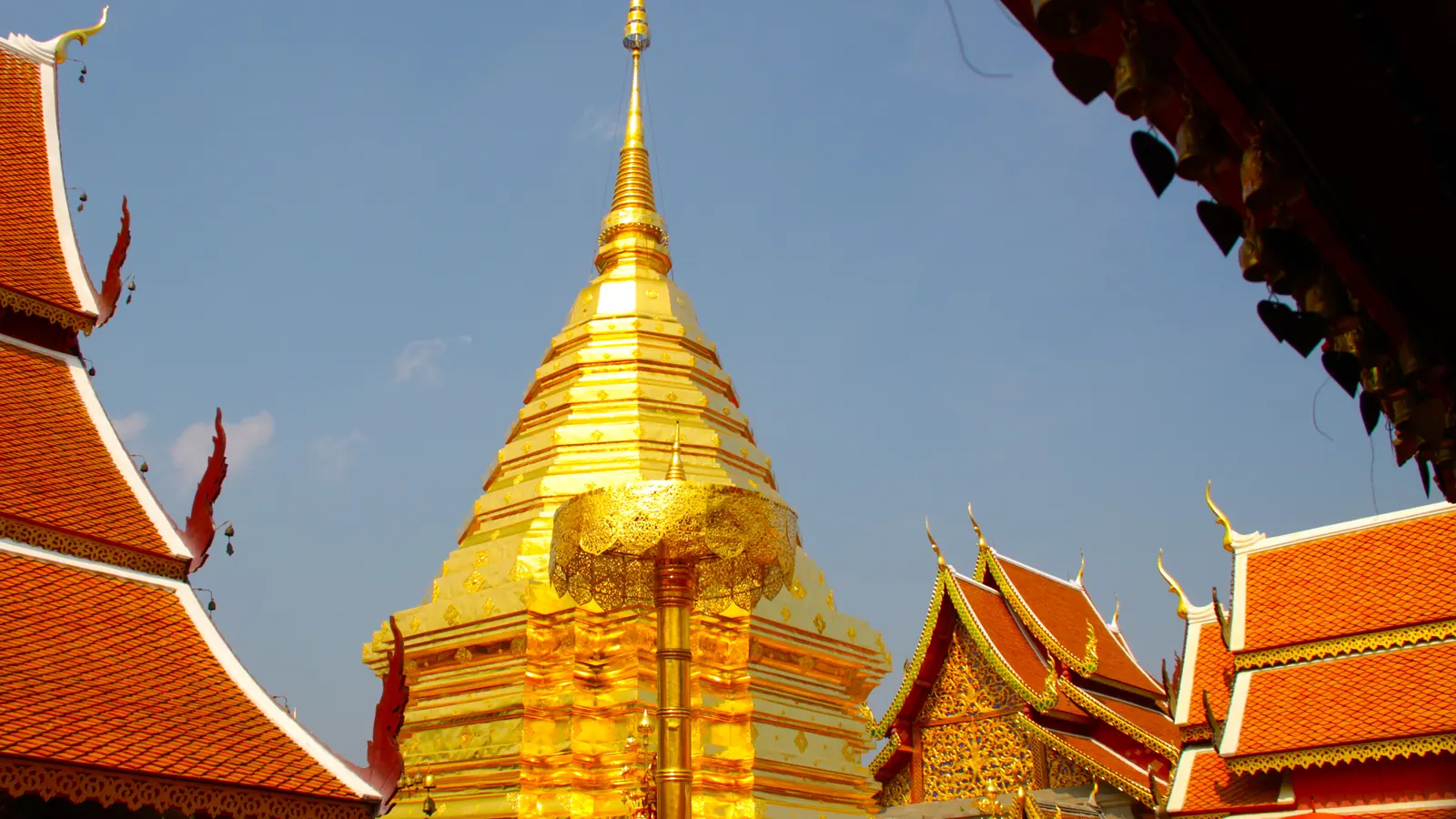
Red songthaew
Best default: one temple, daytime, light bag, flexible return.
One-way Grab
Best middle ground: exact city pickup, but treat the uphill return as a separate decision.
Waiting driver
Worth paying for: exact timing, two stops, rain, or a return you do not want to renegotiate.
Choose the mountain-day format
Remove the part of the route you do not want to improvise
The shared option fixes the route and return without paying for an empty car to wait. The private option buys control over hotel pickup, stop order and the return clock. Compare the format that solves your actual friction.
Decide the return journey before the ride uphill
Doi Suthep is easy to think about as a one-way problem: how do I get from the Old City or Nimman to the temple? That is the wrong half of the decision. The more useful question is what you want to happen when you are finished.
Tourism Authority of Thailand specifically describes Wat Phra That Doi Suthep as easily accessible by Chiang Mai's famous red songthaew, or rod daeng. That makes the shared red truck the sensible baseline, not the fallback. For a straightforward daytime visit, you do not need to turn a well-used local route into a private-car excursion.
But a ride-hailing car or private driver changes the return side. With an exact pickup from your hotel, you remove the first negotiation. With a driver who stays with you, you also remove the question of finding or arranging another vehicle on the mountain. That distinction matters much more than whether one vehicle has air-conditioning.
If your Chiang Mai day already includes several districts, use the route logic in our things worth doing in Chiang Mai guide before adding the mountain. It keeps Doi Suthep in a coherent half-day rather than making you cross the city twice. If you have only just landed, the late Chiang Mai Airport guide is the better first decision; Doi Suthep does not need to be an arrival-night project.
Why the red songthaew is still the best simple answer
The red songthaew works because the product is uncomplicated: shared local transport heading up the same mountain road as every taxi and private car. You give up precise door-to-door control, but you are not giving up access to Doi Suthep.
For a solo traveler or couple, that trade is often attractive. You are not paying for a vehicle to sit while you explore, and a daytime shared ride can feel more straightforward than arranging a private driver for a single stop. It also keeps the transport decision proportional to the day. Doi Suthep is a major Chiang Mai sight, but it does not automatically require a private tour.
The part I would not improvise is the agreement. There is no need to rely on a random old blog fare as if it were an official tariff. Before boarding, confirm the destination, the fare you are agreeing to, whether the vehicle is shared or being chartered, and what happens on the return. If a driver proposes waiting for you, ask how long that wait covers before you say yes.
- “Wat Phra That Doi Suthep?” — confirm the exact destination.
- Confirm the fare for your ride rather than assuming a copied online price is current.
- Ask whether you are joining a shared vehicle or paying for the whole truck.
- If the same driver is meant to bring you back, agree on the meeting point and waiting arrangement.
There is another small physical detail worth planning. TAT notes that the final approach to the temple itself involves either the 306-step Naga staircase or a cable car. A car therefore does not make this a zero-walking outing. If heat, knees or footwear are part of your decision, plan that final ascent separately from the ride up the mountain.
A reserved shared red truck is different from hailing one on the street
There are really two songthaew decisions. The pure local version is the truck you arrange in town, with the fare, sharing and return plan agreed directly with the driver. The reserved shared version is a fixed half-day circuit: you choose a departure, meet at a defined point and keep the same group rhythm through Huay Kaew Waterfall, Wat Pha Lat and Doi Suthep. It still feels like local transport, but the uncertain return has been removed.
The current shared route linked above is unguided. That matters. It supplies the red truck, the sequence and time at each stop; it does not turn the ride into a history lesson. Choose it when your problem is logistics. If you want temple context, ritual detail and someone to interpret what you are seeing, compare a guided small-group tour instead of expecting the driver to become a guide.
A fixed circuit also means accepting somebody else's clock. Travelers who like to photograph every corner of Wat Pha Lat may feel rushed, while visitors who mainly want the golden chedi and city view may spend longer in the truck than they need. Reserve the shared circuit when a clean return matters more than custom stop lengths.
Keep the rest of the day geographically simple. A late-afternoon return works naturally with a Saturday or Sunday walking-street visit, while a mountain morning followed by the Chiang Mai Night Safari needs a real rest and transfer buffer between them. Do not book two timed activities back to back merely because they fit on a calendar.
One-way Grab solves the city pickup, not the whole mountain day
Grab is useful when the part you dislike is finding the first red truck or negotiating from your hotel. Grab currently operates its transport services in Chiang Mai, and the app gives you a defined pickup and drop-off pin with an upfront fare for services such as JustGrab.
That can be a very neat choice from a hotel in Nimman, a side street outside the Old City, or any property where walking to a common songthaew pickup point feels silly in midday heat. Open the app at the hotel, set Doi Suthep as the destination and remove the first handoff.
I would not, however, book a one-way app ride and mentally treat the return as guaranteed. Grab's Chiang Mai coverage tells you the service exists in the city; it is not a promise that a fresh driver will always be waiting at your exact mountain pin at the moment you decide to leave. Network demand, traffic, weather and driver position can all affect an on-demand pickup.
So use one-way Grab when you are comfortable making the return a new transport decision. If the idea of standing outside after the temple refreshing an app would bother you, you want the waiting-driver model instead.
A private driver starts making sense when Wat Pha Lat becomes part of the plan
Adding Wat Pha Lat changes the geometry. You are no longer buying one uphill ride and one return. You are buying a small mountain circuit where the value comes from keeping the same vehicle available between stops.
Grab's current Rent service offers hourly cars with a driver in Chiang Mai, with multiple-hour packages and the vehicle remaining available during the booking period. Grab also makes an important distinction that travelers often miss: the driver is not necessarily English-speaking and is not a trained tourist guide. Think of the service as transport control, not temple interpretation.
Current private-driver products on GetYourGuide make the same distinction in another form. One Doi Suthep and Wat Pha Lat private-driver listing is built around a four-hour private vehicle, hotel pickup and a customizable schedule, while explicitly excluding a tour guide. That is exactly the format I would compare when your real problem is coordinating two mountain stops, not learning their history from a guide.
This is especially useful if one person in your group wants longer at Doi Suthep while another would rather keep Wat Pha Lat brief. A shared transport rhythm is cheap when everybody wants the same thing. A waiting car earns its value when your timing preferences are uneven.
Hotel location changes convenience, not the mountain route
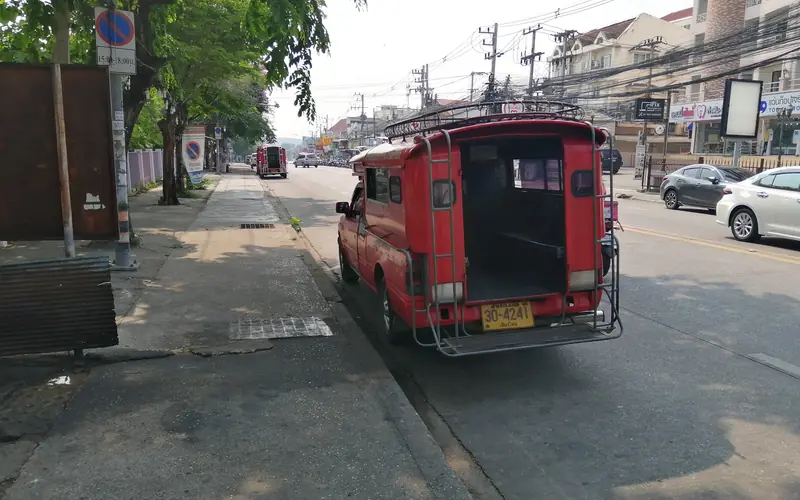
Old City and Nimman travelers often describe Doi Suthep as if one district has a secret shortcut. It does not. Both ultimately feed toward Huay Kaew Road and the same mountain ascent. Your hotel location changes how easily you reach a pickup point and how much city traffic you meet before the climb; it does not create a different road to the temple.
From Nimman, a direct app car can feel unusually efficient because you are already on the western side of the city. From the Old City, a reserved shared departure may save more mental effort than walking around hoping the next red truck is the one you need. From the Night Bazaar or riverside, exact hotel pickup has a stronger case because the city approach is longer and your morning starts farther from the mountain.
None of those differences justify reshaping your entire hotel choice around Doi Suthep. This is one half-day, not the journey you repeat every morning. Choose a Chiang Mai base for the streets, food and evening rhythm you will use repeatedly, then pay for a more convenient pickup on the single mountain day if you need it.
Rain changes the value of waiting more than the value of speed
A private car does not magically beat mountain-road traffic. The same road carries red trucks, taxis, Grab cars and private vans. What it changes is how much exposed waiting and renegotiation you have between the temple and your return.
That is why rain pushes me toward a kept driver more than it pushes me toward a “faster” vehicle. If showers are moving through Chiang Mai, the useful luxury is knowing where your ride is and being able to get back into it, not shaving a theoretical few minutes off the road.
Peak dates are another case where expectations matter. Chiang Mai authorities have documented special traffic management for Doi Suthep during major events and busy periods. A private booking may make your logistics calmer, but it cannot reserve an empty mountain road. If you have an evening flight, train or hard restaurant booking, leave slack rather than paying for a driver and assuming that makes the clock deterministic.
If that hard connection is actually an intercity move, separate the decisions. Our Chiang Mai to Chiang Rai bus vs private transfer guide handles the northbound handoff, while Bangkok to Chiang Mai sleeper vs flight is about the intercity leg into Chiang Mai. Do not let a mountain outing consume the buffer for either.
For a solo woman, daytime shared transport can be the lower-friction choice
There is no rule that “private” is automatically the more comfortable option for a woman traveling alone. In daylight, a shared red songthaew on a familiar visitor route can be simple: other passengers, a clear destination and no need to spend the whole outing one-to-one with a driver.
The answer changes when the conditions become less tidy. I would lean toward a booked or waiting car if you expect to return after dark, heavy rain is likely, you are carrying expensive camera gear you do not want to keep moving between vehicles, or you simply do not want to negotiate a second ride while tired.
Keep your phone, cash, passport and valuables on your body rather than loose in an open bag. If you use an app ride, check the plate and driver details before getting in and share the trip if that is part of your normal routine. Grab's current Rent information also lists Share My Ride, driver ratings and trip history among its safety features.
If mobile data is not already sorted, fix that before leaving the hotel rather than using the mountain as the place to troubleshoot connectivity. Save the temple pin, your pickup point and the driver's details before the climb. A screenshot is useful when coverage fluctuates or you need to show a Thai place name without relying on pronunciation.
Do not choose a scooter just because it removes the waiting
A scooter looks like the ultimate freedom option on a map: leave when you want, stop where you want, come back when you want. The trade-off is that you also take responsibility for the mountain road, weather, parking and your own riding skill.
For an experienced licensed rider who is already comfortable with local conditions, that may be acceptable. For a first-time scooter rider, Doi Suthep is a poor place to learn just to avoid a songthaew wait. Transport convenience is not a good reason to add a riding-risk problem to a straightforward sightseeing morning.
Build the rest of the day around energy, not empty map space
Doi Suthep looks close to central Chiang Mai on a map, but the outing includes city pickup, the winding ascent, the final staircase or cable car, temple time and the return. Treat it as a proper half-day. The mistake is not spending too long at the mountain; it is booking something rigid immediately afterward and then watching the clock through the temple.
On a hot or rainy day, a flexible indoor stop such as Art in Paradise Chiang Mai is easier to pair than another long road excursion. If the next priority is an ethical elephant visit, keep it on a separate day and use our Elephant Nature Park decision guide to understand why pickup windows and program length deserve their own space.
The same rule applies to Chiang Rai. A White Temple day trip from Chiang Mai is a long out-and-back journey, not a clever extension of Doi Suthep. Put those on different days so the mountain temple feels like a visit rather than the opening checkpoint in a transport marathon.
Four trip shapes, four sensible choices
Use a red songthaew. Keep the plan simple and agree the fare/return arrangement before boarding.
Use Grab uphill if exact hotel pickup is the useful part; decide the return separately unless you book a waiting driver.
Keep a driver. The second stop is where hourly/private transport begins to buy real coordination rather than just privacy.
Pre-arrange the car and still leave traffic slack. The value is return certainty, not a promise of a faster mountain road.
My pick
I would use the shared red truck for a straightforward daytime visit when Doi Suthep is the main event and the return does not have to land on an exact minute. I would keep a private driver only when Wat Pha Lat is genuinely part of the plan, the group wants different stop lengths, rain is likely, or a hard return makes a second negotiation a bad bargain. One-way Grab is the useful middle option for an awkward hotel pickup, but it should never be mistaken for a complete return plan.
Lock in the version that fits
Match the booking to the return you need
Use the shared departure when a fixed circuit is enough. Pay for the private car only when its pickup and waiting time solve a real problem for your group.
Pair this with one easy second decision
More Chiang Mai and arrival planning
Sources checked for this update: Tourism Authority of Thailand on Wat Phra That Doi Suthep access; Grab Thailand on current Chiang Mai ride and hourly-driver services; the current shared red-truck circuit; and the current Doi Suthep plus Wat Pha Lat private-driver format. Operational details can change, so recheck your chosen service close to travel.